

The moment you put your logo on a cargo bike, EU law treats you as its manufacturer — with all the liability and, too often, none of the differentiation. That single fact reframes the whole private-label decision. The right first question is not “should I build my own family cargo bike or resell someone else’s?” It is “which parts of this product will actually be defensible once my name is on it?” Get that wrong and you inherit a manufacturer’s legal duties for a frame that five competitors also sell. Get it right and you own a brand that price-cutters can’t copy.
This is the bottom-of-funnel companion to where the demand sits and what makes a family cargo bike sell. If you’re sourcing, start here.
White label, private label, ODM — and the MOQ reality
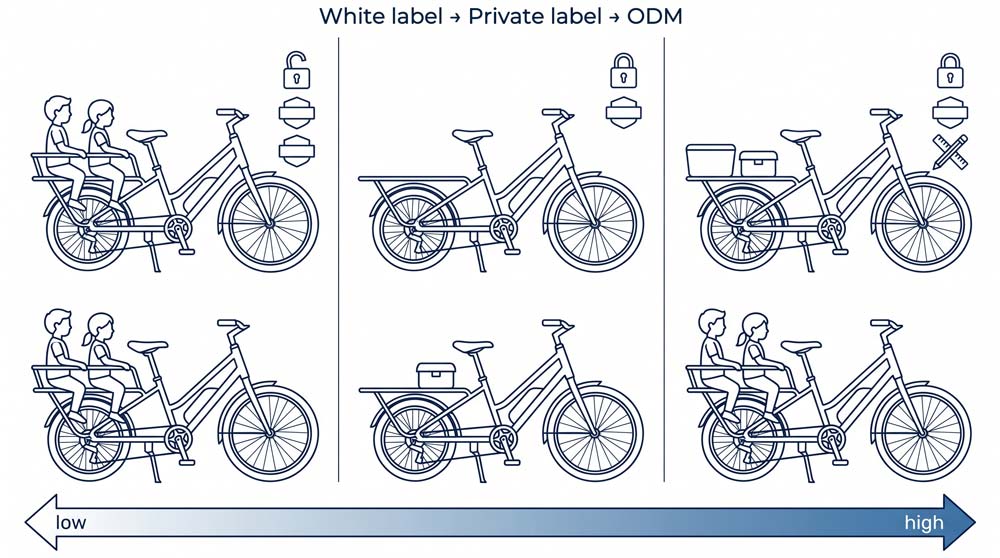
The terms get used loosely, and the difference decides whether you have a moat:
- White label — a generic, finished product you rebrand. Low minimum order quantities, fast to market, but the same bike is sold to your competitors. It is a market-entry mechanism, not a strategy.
- Private label / ODM — a product developed or meaningfully configured to your specification and sold exclusively under your brand. Minimums are higher (often 100–300 units for genuine exclusivity, and many European cargo bike makers set ODM floors at 500+), but you own a differentiated product.
MOQ is not arbitrary gatekeeping; it reflects the economics of tooling, component sourcing, and a dedicated QA run built around your configuration. The practical test of which you’re being offered is one question to the factory: “Do you sell this exact configuration to other distributors?” If the answer is vague, assume white label and price the risk accordingly. Browse the supply base in our cargo bike manufacturers directory.
The white-label trap: you brand it, you own it
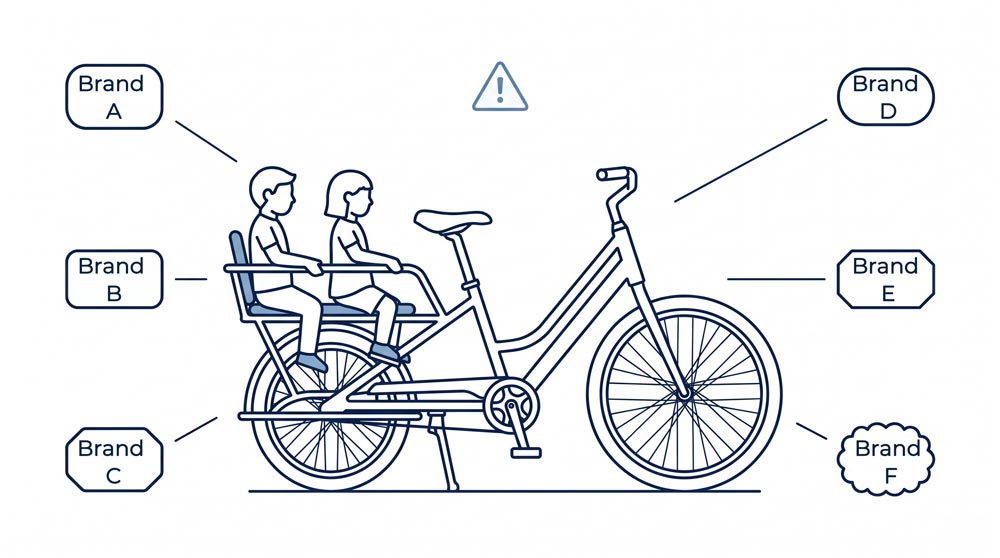
This is the part most new entrants discover too late. Under the EU’s General Product Safety Regulation (Regulation 2023/988), anyone who places a product on the market under their own name or trademark is legally the manufacturer — assuming the full, non-delegable duties of one, regardless of who physically built it. That means a risk analysis, a technical file, full traceability, the relevant CE/standard conformity, and an EU Responsible Person if you sit outside the EU, as compliance specialists set out plainly (GPSR manufacturer obligations; repackaging vs manufacturing under GPSR). Contracting an OEM in Asia does not move that responsibility — it stays with the brand on the downtube.
So the trap is this: white label gives you a manufacturer’s liability without a manufacturer’s differentiation. If your “own brand” bike is a generic frame also sold under four other names, you carry the full legal and reputational risk of a child-carrying product while competing on nothing but price — and your position collapses the day a rival identifies and undercuts your base model. The Babboe frame-crack scandal is the cautionary extreme of brand-level liability landing on whoever’s name is on the bike; we cover it in manufacturing mistakes.
Where defensibility actually lives
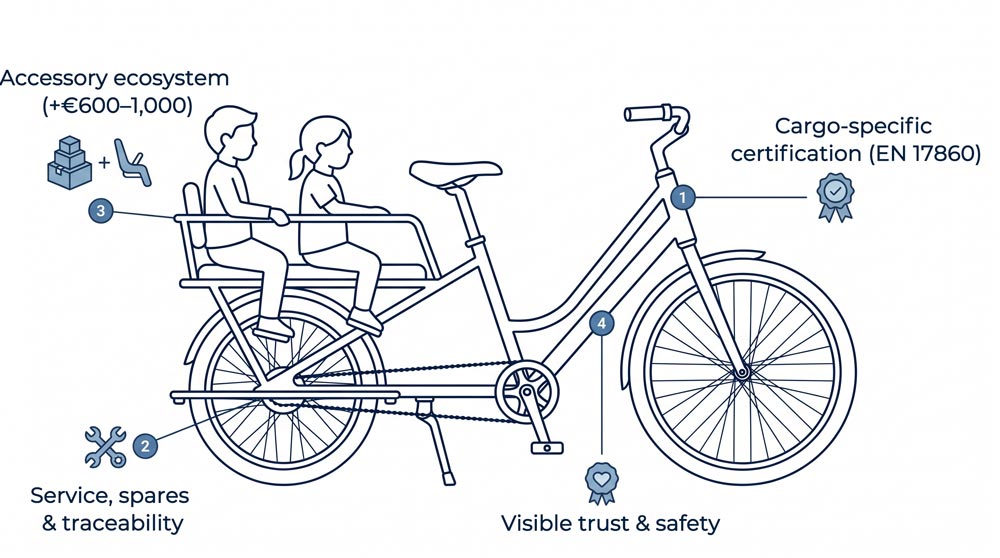
If a logo is not a moat, what is? Four things you can own, none of which is the bare frame:
- Certification and compliance done right. Owning a proper EN 17860 conformity — not a borrowed EN 15194 e-bike test never meant for a 300 kg load — is both a legal necessity and a sales asset, as our safety guide explains. The brand that can show purpose-built cargo certification differentiates on exactly the dimension a family cares most about.
- After-sales and service infrastructure. A spares pipeline, serial-level traceability, and a local service path are what let you honour a warranty, run a recall, and win municipal or fleet tenders. This is the moat nobody photographs — and the one that decides repeat business.
- An accessory ecosystem and configurability. Seats, boxes, covers, and the “2+1” upgrade path add €600–€1,000 of margin per bike and lock customers into your platform. A configurable system is far harder to clone than a frame.
- Brand trust, earned visibly. Named certifications, factory-supplied safety documentation, and honest pros-and-cons selling (the playbook in our safety guide) build the word-of-mouth that price-led white-label rivals structurally cannot.
Spec the frame last. Own these four first. The sharpest current proof is that the brands winning this market own a signature, not a frame: Ca Go owns “the crash-tested safety cell” and TENWAYS owns value-band user experience — each an ownable position a generic rebrand can’t copy. A private-label line needs its own such signature (a safety system, a UX detail, a service promise), decided before the frame.
The sourcing gates
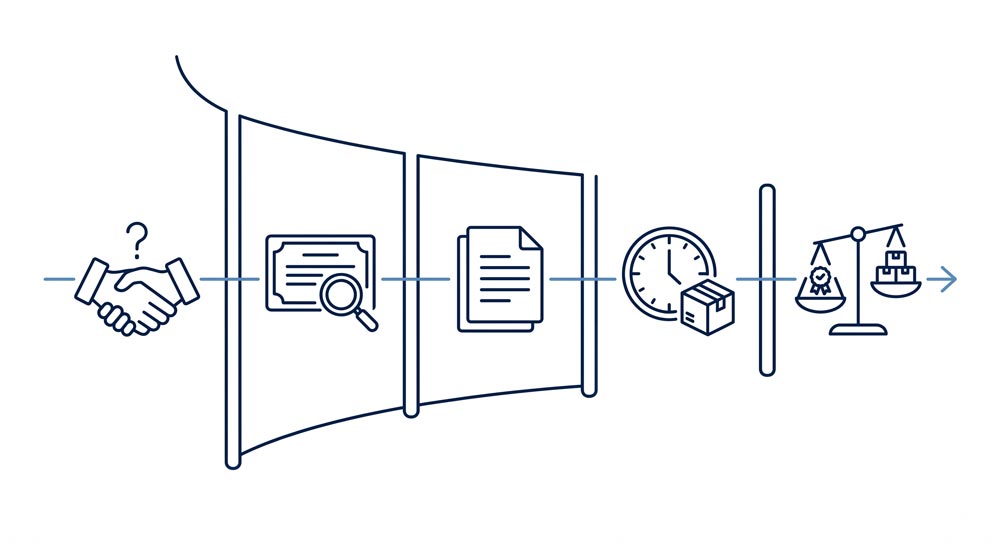
Before you commit a PO, run every candidate partner through a short, non-negotiable checklist:
- Exclusivity — get a written answer on whether your configuration is sold to competitors.
- Real certification, not claims — demand the EN 17860 and UL 2849/2271 test reports, not a line on a brochure. Verify against the lab’s directory.
- Factory-built safety documentation — require paper and digital safety/usage guides in your market’s language as a line item in the contract; it is cheap at source and central to the trust play.
- Lead times and capital — cargo-specific motors and batteries run 16–24 week lead times, and our B2B procurement guide models the working capital (a six-figure minimum to breakeven) most new entrants underestimate.
- MOQ versus customisation depth — match the minimum you can fund to the exclusivity you actually need; don’t buy 500 units of differentiation you won’t use, or 50 units of a bike everyone else sells.
Match the platform to the region
The build-or-resell question also answers differently by market, following the two business models from our market analysis. A European premium platform earns its keep on the moat of certification and accessories — worth the higher ODM investment. A North American value platform competes on the lowest credible all-in price and bundle, where deep customisation matters less and speed-to-shelf matters more. Decide which game you are playing before you spec the bike, because the two demand different bills of materials, channels, and after-sales math.
The bottom line
Private label only pays when you own something a competitor can’t rebrand around: real cargo-specific certification, a working service and spares operation, a sticky accessory ecosystem, and visible trust. White label gets you to market fast but hands you a manufacturer’s full liability for an undifferentiated frame — the worst trade in the category. Decide what will be defensible first; choose build-versus-resell second; spec the frame last.
Continue the cluster: The family cargo bike market in 2026 · What makes a family cargo bike sell · Are cargo bikes safe for kids? · Family Cargo Bike pillar guide. Tools for sourcing: the cargo bike manufacturers directory, the brands directory, and the B2B procurement guide.
Editorially independent. cargobikehub.com has no commercial relationship with the operators named. Pricing, subsidy and policy figures are drawn from operator statements and public sources current as of June 2026; subsidy windows and rules change frequently — verify locally before acting. This is not financial advice.


