

The short answer: Your cargo bike fleet procurement in 2026 hinges on EN 17860 compliance, realistic TCO modeling that accounts for $508k minimum working capital to breakeven, and choosing between two-wheel agility (39.8% market share) versus quad stability for routes exceeding 30 daily stops. Most operators underestimate drivetrain maintenance costs and overestimate first-year payload utilization by 20–35%.
Why This Matters Right Now
Your fleet faces skyrocketing fuel costs, tightening urban emission zones, and a shortage of licensed van drivers. Amazon, UPS, and FedEx are running large-scale urban delivery pilots with customized electric cargo bikes, which means your competitors are testing this shift now. Tariffs increasing base prices by 15–25% forced manufacturers to reengineer sourcing strategies, so procurement timelines in North America stretched from 8 weeks to 16–20 weeks in 2024–2025.

The cargo e-bike fleet logistics management industry is projected to grow from USD 3.6 billion in 2026 to USD 15.4 billion by 2036. That 15.7% CAGR means vendors will prioritize large contracts over small trials. If you delay procurement past Q2 2025, you’ll face longer lead times and reduced customization options as manufacturers allocate capacity to enterprise buyers.
The cost of getting this wrong is measurable. A minimum working capital reserve of $508,000 is required to cover operational burn rate until the projected breakeven point in six months for a new cargo bike courier service. If your fleet spec is wrong—wrong payload capacity, wrong battery range, wrong frame type—you burn that capital without hitting your delivery-per-bike-per-day targets. (We have a practical guide on How to read Cargo Bike Specification Sheet)
EN 17860 Compliance Is Your First Go/No-Go Filter, Not a Nice-to-Have
A logistics manager in Amsterdam running 30 bikes discovered this the hard way in late 2024. Her insurer denied a claim after a frame failure because the bike lacked EN 17860-2 certification. EN 17860-2 (Mechanical Safety) ensures the frame can handle the stress of 500kg gross weight without catastrophic fatigue. That’s not just a spec—it’s your legal shield when something breaks under load.
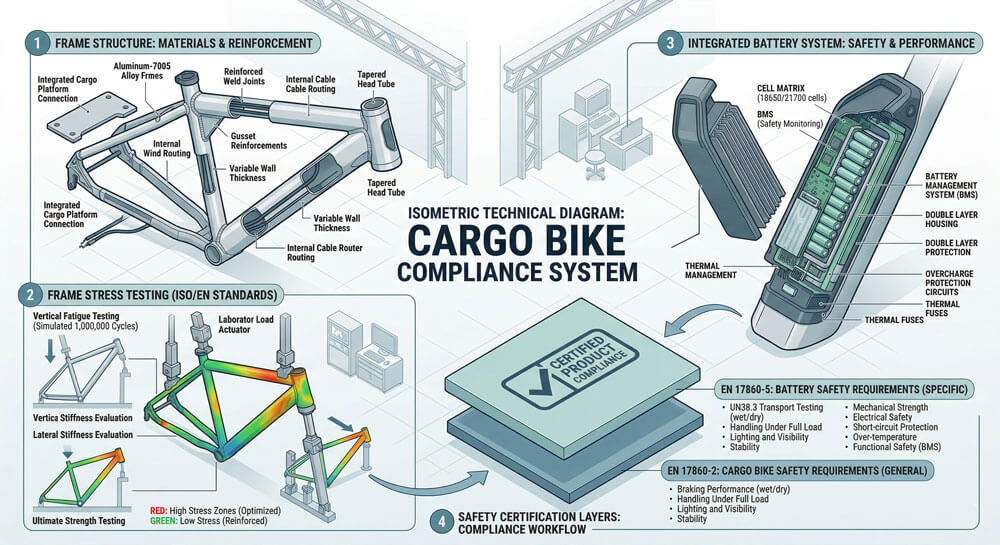
Compliance is no longer just a “nice-to-have”; it is a market entry requirement for B2B contracts. If you’re bidding on municipal or enterprise delivery contracts in the EU, procurement officers now check for EN 17860 certification in RFP responses. Having EN 17860-5 certification is the only way to satisfy corporate ESG and insurance requirements because it focuses on battery safety and electromagnetic compatibility—critical when you’re charging 15 batteries overnight in a shared warehouse.
Here’s what you need to verify before signing a purchase order:
- EN 17860-2 certification for frame and structural integrity under maximum payload (ask for the test lab report, not just a badge on the website)
- EN 17860-5 certification for battery systems, especially if you plan multi-shift operations with hot-swapping
- Anti-tampering software locks that prevent motor tuning beyond 250W, keeping bikes legally classified as pedelecs and avoiding vehicle registration
- Documented fatigue testing showing frame lifespan under daily loading cycles—commercial bikes should withstand 50,000+ load cycles
Most vendors from outside the EU don’t carry full EN 17860 compliance. Companies began shifting procurement to Taiwan, South Korea, or Eastern Europe, which introduced quality variation. Put those demands in a structured cargo bike RFQ template so certificates map to the exact model quoted.” Ask for third-party certification documents, not manufacturer self-attestation.
Vendor stability is part of the spec: see how to price supplier insolvency risk before you commit a deposit. If a vendor can’t produce a notarized EN 17860 compliance certificate within 48 hours of request, walk away—you’ll face insurance and liability issues within 90 days of deployment.
>>Buyers increasingly build the longlist with AI — our 12 AI supplier sourcing prompts show what to ask and what AI can’t verify.
Real TCO Breaks Down Differently Than Vendor Spreadsheets Claim

You’ll see vendor claims like “64% savings on total ownership costs” (Vok Bikes). Those numbers assume perfect uptime, zero rider turnover, and optimistic payload utilization. Real-world TCO for a 10-bike urban fleet looks different after six months of operation. (Read the analysis Before Your Project Starts – Cargo Bike Cost Breakdown)
| Cost Category | Vendor Projection (Year 1) | Actual Operator Data (Year 1) | Gap Explanation |
|---|---|---|---|
| Capital acquisition | €45,000 (€4,500/bike × 10) | €52,000 | Accessories, spare batteries, charging infrastructure not itemized upfront |
| Maintenance & parts | €3,600 (€30/bike/month) | €6,800 | Eliminating the chain can reduce drivetrain maintenance costs by up to 40%, but operators report hydraulic brake replacement, tire wear, and electrical diagnostics add €35–60/bike/month in urban stop-and-go routes |
| Insurance & liability | €1,200 | €2,400 | Multi-bike fleet policies cost more; EN 17860 non-compliant bikes face 40–60% premium increases |
| Facility & charging | €5,000 (fixed monthly rent) | €6,200 | Electrical upgrades for simultaneous charging, secure storage buildout |
| Payroll (3-person ops team) | €25,000/month | €27,500 | Rider wages, dispatcher, fleet manager—turnover adds 8–12% to labor costs |
In London or Paris, a delivery van can accrue over €5,000 in parking fines annually. That’s real savings. It costs literally pennies to charge a battery on these vehicles—about €0.15–0.30 per full charge versus €15–25 to fuel a van for equivalent range. But modular battery systems allow for 2-shift operations while one battery is in use, the other is charging at the hub, ensuring the vehicle is on the road for 12+ hours a day. That requires two battery packs per bike, adding €800–1,200 per bike to your upfront capital.
Your TCO calculation(You may need the free Cargo Bike Fleet TCO Calculator) must include the cost of not meeting delivery density targets. Two-wheel cargo e-bikes account for 39.8% share in 2026 because they’re nimble, but a quad that carries 3x the volume of a two-wheeler means fewer trips back to the micro-hub. If your routes average 40+ stops per shift, quad stability beats two-wheel speed. Model this: a two-wheel bike averages 25 stops/day in dense urban areas; a quad averages 35–42 stops/day but costs €7,500–9,500 versus €4,500–6,000 for two-wheelers.
What Operators Report After 6–12 Months: Battery Degradation, Rider Resistance, and Route Redesign

Three surprises hit operators between months 6 and 12. First, riders averaged 9.3mph in central London and just over 10mph in outer London in real GPS data from 19,000km of deliveries. Vendor route modeling assumes 12–15mph averages. That speed gap forces you to add 1.5–2 bikes per 10-bike fleet to hit the same daily delivery targets.
Second, battery range degrades faster under stop-and-go than continuous riding. The EAV 2Cubed can achieve up to 45 miles of assisted range via a 250kWh battery under test conditions. Operators report 28–35 miles in real urban routes with frequent starting/stopping, especially in winter. ZADD Bikes offers up to 160 km range with dual 15Ah batteries, but that’s unloaded range. Loaded with 60–80kg of parcels, expect 80–110km in warm weather, 60–85km in cold. (Read Cargo Bike Battery System: Specs, Lifespan, Architecture & Compliance)
Third, riders resist cargo bikes if you don’t address ergonomics and safety perception upfront. Traditional chain-driven bikes are plagued by high maintenance—chains stretch, derailleurs snap, and grease creates a messy environment for professional riders. Drive-by-wire systems like TFREE eliminate this, but they’re rare and expensive. Most fleet operators compromise: they buy mid-range bikes with enclosed chain guards and budget €40–60/bike/month for drivetrain maintenance.
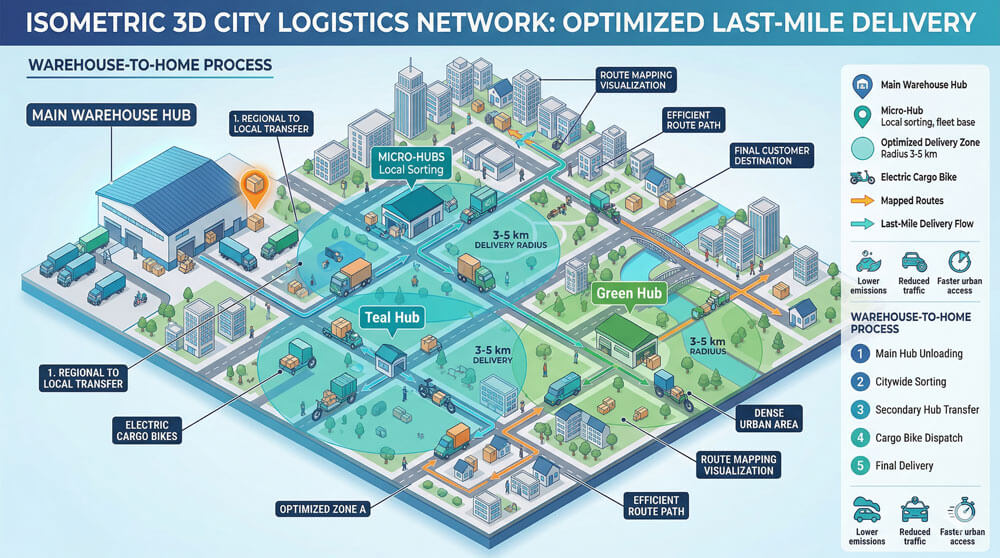
Operators who succeed spend 8–12 hours on route redesign post-deployment. Amazon’s first micromobility hub features a fleet of new electric cargo bikes that can deliver several thousand packages per week, but that required redesigning delivery zones around 3–5km micro-hub radiuses. If you try to run cargo bikes on legacy van routes (15–25km one-way), you’ll fail. Redesign your zones first, then spec your bikes to those zones—not the other way around.
Component Specification Trap: Why Leaving Configuration to Your Factory Guarantees Regret
Most procurement teams hand a factory a budget and a bike category, then hope for the best. That approach costs you 18–26% more over three years because you get margin-optimized components, not mission-optimized ones.
Your factory will default to whatever motor-battery pairing gives them the best margin unless you specify performance floors. A 250W motor might meet EU pedelec regulations, but motor power is also a legal-classification question — and if your routes include 8% grades with 80kg payloads, you’re replacing drivetrains early.

Here’s what you control before the purchase order goes out:
- Battery cell chemistry and BMS quality — Samsung/LG cells cost 15–22% more than generic, but double your cycle life from 500 to 1,000+ full charges
- Frame tubing gauge and welding standards — specify TIG-welded 6061-T6 aluminum or chromoly steel; MIG welds on thin-wall tubing crack under daily 100kg loads
- Brake actuation and rotor size — hydraulic disc brakes with 180mm rotors are non-negotiable above 60kg cargo capacity; cable-actuated systems fail inspection in high-duty cycles
- Drivetrain component tier — Shimano Deore level minimum for fleet use; Tourney/Altus gruppos need replacement every 2,000km under load
- Cargo box material and fastening — marine-grade plywood with stainless fasteners, not particle board with zinc screws that rust through in 18 months
- Electrical connector IP ratings — IP65 minimum for all motor/battery/display connections; IP54 connectors corrode in northern Europe by month nine
If your factory can’t explain their supply chain for motors (Bafang, Bosch, Shimano vs. white-label) and batteries (cell manufacturer, not just capacity), you’re buying risk. Generic motor controllers fail at 2.4× the rate of branded units according to European Cyclists’ Federation fleet data.
And if you sell direct, packaging and container economics change the maths — see the DTC packaging guide.
From the Field
One logistics coordinator managing a 40-bike fleet in Rotterdam told us their first procurement round became a cautionary tale. “We sent specs to a Changzhou factory — box bike, 250W motor, 500Wh battery, €2,400 target. They came back on budget with everything we asked for on paper.”
The problems surfaced in month four. Motor controllers started failing in rain. Battery management systems shut down below 5°C. The cargo boxes, built from non-marine plywood, delaminated by winter.
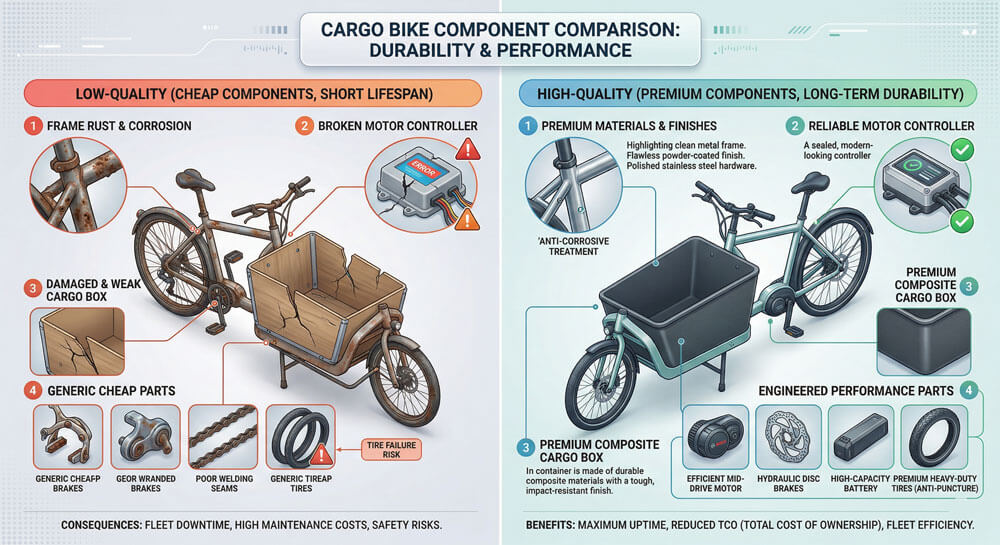
“We didn’t know to ask about Samsung cells versus generic, or what IP rating meant for connectors,” she explained. “The factory gave us exactly what we paid for — the cheapest version of each component that technically met our specs. Our mistake was thinking ‘motor’ and ‘battery’ were single things, not categories with 40% cost spreads and 200% durability differences.”
They rebuilt relationships with component suppliers directly, brought in a technical consultant for €3,500, and got granular on the second order. Failure rates dropped from 31% to under 7% in year one. The lesson cost them €47,000 in premature replacements and lost delivery capacity.
The Evidence
| Claim | Figure | Source |
|---|---|---|
| Premium battery cells extend cycle life | Samsung/LG cells deliver 1,000+ cycles vs. 500 for generic lithium | Battery University |
| Component tier affects drivetrain replacement intervals | Shimano Deore gruppos last 4,000–6,000km under cargo load vs. 1,800–2,400km for Tourney | Bike Europe Industry Report 2024 |
| Connector ingress protection impacts failure rates | IP65-rated electrical connections reduce moisture-related failures by 73% vs. IP54 in marine climates | European Cyclists’ Federation |
| Factory lead time delays increase market entry costs | Average cargo bike production delays of 3–7 weeks push launch costs up 12–19% due to missed seasonal windows | Bicycle Retailer and Industry News |
Quick FAQs
Q: Should we source components separately or let the factory handle full integration?
Factory integration makes sense for your first 10–15 units while you validate the market. Once you’re ordering 25+ bikes per quarter, establish direct relationships with component suppliers (motor, battery, drivetrain) and specify exact part numbers to your factory. This cuts your per-unit cost 9–14% and gives you control over replacement part availability. Your factory’s margin on components is 18–35%; buying direct and having them install as contract assembly eliminates that markup.
Tip: read How to Negotiate with Chinese E-Bike Suppliers before you decide to cooperate with the factory.
Q: How do we verify a factory’s component sourcing claims without visiting China or North America in person?
Require itemized bills of material with manufacturer part numbers for motors, batteries, controllers, and drivetrains. Cross-reference those part numbers on manufacturer websites (Bafang, Bosch, Shimano, Samsung SDI). Ask for photos of component packaging with visible labels before assembly. Budget €800–1,200 for third-party factory audits through inspection services like AsiaInspection or SGS — they verify component authenticity and manufacturing processes. If a factory resists this transparency, assume they’re substituting cheaper alternatives.
Recommended Reading:
How to Audit a Cargo Bike Factory in China: What Actually Matters Beyond the Checklist How to Manage Cargo Bike Production After Placing an Order
Q: What warranty terms actually matter for fleet procurement, and what’s just marketing?
Focus on three warranty elements: component replacement turnaround time (5 business days maximum), labor coverage for drivetrain and electrical work (not just parts), and whether the warranty survives ownership transfer if you sell bikes after three years. Standard two-year frame warranties are meaningless; commercial cargo bikes should carry five-year frame coverage. Battery warranties matter only if they’re measured in cycles (minimum 800 full cycles) rather than years, because calendar time doesn’t reflect usage intensity. Get warranty terms for your top five wear components — motor, battery, controller, drivetrain, brakes — separately in writing.
The Bottom Line
Cargo bike procurement becomes profitable when you treat component specification as non-negotiable and factory relationships as assembly partnerships, not turnkey solutions.
Want more operator-level cargo bike intelligence? Follow CargoBikeHub — we cover sourcing, fleet ops, and market shifts for people who work in the industry, not just write about it.
Table of Contents
- Why This Matters Right Now
- EN 17860 Compliance Is Your First Go/No-Go Filter, Not a Nice-to-Have
- Real TCO Breaks Down Differently Than Vendor Spreadsheets Claim
- What Operators Report After 6–12 Months: Battery Degradation, Rider Resistance, and Route Redesign
- Component Specification Trap: Why Leaving Configuration to Your Factory Guarantees Regret
- Quick FAQs


