

The short answer: Cargo bike manufacturing looks like e-bike manufacturing on paper and behaves like a different industry on the factory floor. Frame fatigue requirements double, certification (EN 17860) is younger and stricter than EN 15194, and a single recall can swallow a brand — Babboe pulled 22,000+ units off the road in 2024 over hairline frame cracks and is still paying for it. The market is real (global e-cargo growing from USD 3.62B in 2026 to USD 8.73B by 2034, an 11.6% CAGR per Fortune Business Insights), but the cost of failure is 3–5× higher than e-bikes. If you’re entering the category — or switching suppliers — treat factory selection, certification verification, and pilot validation as the project, not the paperwork.
Below are the five mistakes that quietly kill cargo bike manufacturing projects — in the order they show up.
Mistake #1: Treating Cargo Bikes Like Bigger E-Bikes
Walk any Asian or European bike fair and you’ll hear this from new brands and even some experienced e-bike OEMs: “It’s basically an e-bike with a longer wheelbase and a box.”
It isn’t. And that gap between what a cargo bike looks like and what it has to survive is where most cargo bike manufacturing projects quietly bleed money for 12–18 months before the founders realize they’re not running an e-bike business anymore.

Three structural differences hit on day one:
- Loads are 3–6× higher. EN 17860 covers single-track cargo bikes up to 300 kg gross weight, multi-track up to 300 kg, and heavy cargo up to 650 kg. A standard EPAC under EN 15194 doesn’t model that.
- Duty cycles are commercial. 54.66% of EU e-cargo bike sales went to commercial delivery in 2025 (Mordor Intelligence). Commercial fatigue tests under EN 17860 require 200,000 pedaling cycles vs. 100,000 for private use — double the test, double the failure points.
- The rider isn’t the only person at risk. Two kids in the box, a €4,000 grocery order, a refrigerated pharmacy load. When the frame fails, liability is not theoretical.
This is why cargo bike manufacturing is closer in spirit to light commercial vehicle production than to recreational e-bike assembly.
Mistake #2: Trusting EN 15194 When EN 17860 Has Moved the Goalposts
Until 2024, most cargo bike makers leaned on Germany’s DIN 79010:2020 (only enforceable in Germany) or stretched EN 15194, the EPAC standard, which never contemplated 300 kg payloads or kids in front-loaders. That gap is exactly what produced the Babboe scandal: hairline frame cracks the company reportedly knew about and concealed, leading to a Dutch criminal investigation and a global recall.
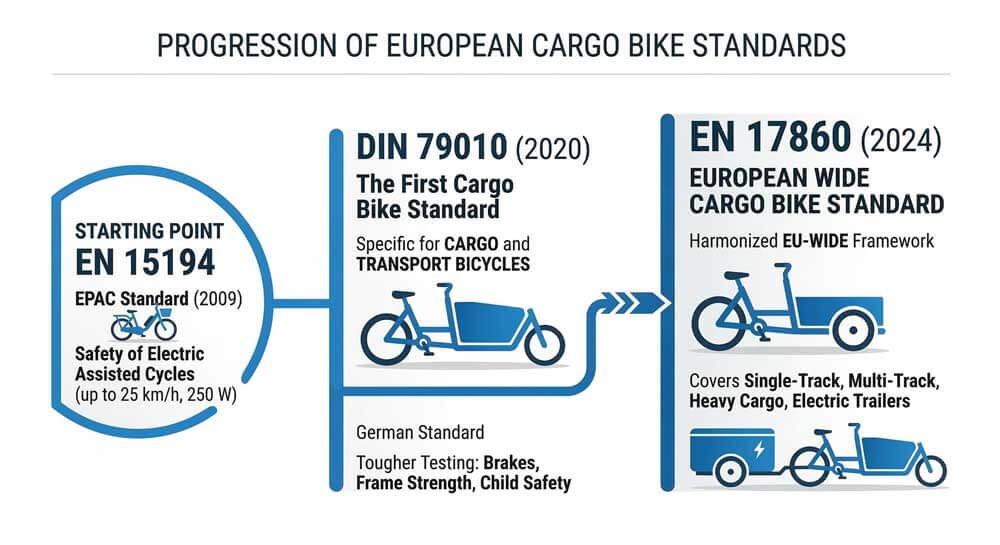
The EU’s response — fast-tracked through CEN/TC 333/WG 9 — is EN 17860:2024, a seven-part series ratified beginning July 2024. It explicitly covers:
- Single- and multi-track carrier cycles, plus heavy cargo (650 kg) and electric trailers
- Commercial vs. private use, with separate fatigue thresholds
- EN 17860-5 for electrical/EMC requirements specific to cargo geometry, beyond what EN 15194 captures
- Tip-over angles (4.6° lateral, 5.7° front-rear, both empty and at 100% payload), per SGS testing notes
For B2B buyers, the practical effect is simple: insurance underwriters, municipal RFPs, and serious last-mile clients are starting to ask for EN 17860 certification by part number. Self-attestation is not a substitute. If a factory hands you a “CE certificate” without naming which standard, you’re holding a marketing document.
Your EN 17860 Pre-Order Checklist
Before signing any cargo bike manufacturing PO, verify the factory can produce:
- Third-party lab report on letterhead (SGS, TÜV, ACT Lab) — not a factory PDF
- Specific EN 17860 part cited (e.g., 17860-2 mechanical, 17860-5 electrical) — “EN 17860 compliant” alone is not enough
- Commercial-use fatigue test data (200,000 pedaling cycles) if your bikes will run delivery duty
- Battery pack compliant to EN 50604-1 — referenced inside EN 17860-5
- Tip-over angles tested at 100% payload — empty-bike testing is the old DIN trick
- Frame welding records with welder certification numbers — TIG-qualified for cargo gauges
If a factory can’t produce these within 48 hours of request, you don’t have a cargo bike supplier. You have an e-bike factory hoping you won’t ask. A solid procurement walk-through lives in the Cargo Bike Manufacturers directory and the Specification Sheet reading guide.
Mistake #3: Assuming Your E-Bike OEM Can Just “Scale Up” the Line
Most e-bike OEMs cannot build a compliant cargo bike on their existing line without retooling. The honest ones will tell you that. The dishonest ones will quote you anyway.

Here’s the gap, in plain terms:
- Welding. Standard MIG welds on thin-wall 6061 aluminum crack under daily 100 kg+ loading. Cargo frames want TIG welding on heavier-gauge tubing — and welders certified to it. That’s a labor-skill issue, not a machine issue.
- Jigs and fixtures. A long-john front-loader needs a frame jig that holds a 1.7–2.0 m wheelbase square within ±0.5 mm. E-bike jigs don’t.
- Linkage steering. Front-load box bikes use a steering linkage that has its own failure mode catalogue — slop, corrosion, fatigue at the rod ends. Most e-bike factories have never built one.
- Cargo box construction. Marine-grade plywood with stainless fasteners, or composite shells with proper UV-stable resins. Particle board with zinc screws is what landed Babboe’s frames in landfills.
- QC infrastructure. Vibration and drop testing, IP65 connector validation, brake-rotor heat cycling. None of this is standard on an e-bike line.
Component cost is honestly the smaller problem. Tooling, training, and rework capacity are where new brands underestimate by 25–40%. The full breakdown lives in our Cargo Bike Cost Breakdown — read it before you ask a factory for a quote.
More related reading:
- The Complete Cargo Bike Sourcing Guide: Factory Audit, Supplier Negotiation & Production Control
- Cargo Bike Fleet TCO Calculator — True Cost of E-Cargo Bike Ownership in Europe
Mistake #4: Letting Cool Designs Skip the Manufacturability Review

Eurobike 2024 and 2025 floors were full of striking cargo concepts: extendable platforms, hydrogen fuel-cell pedelecs, AI-assisted training wheels. A working prototype is not a manufacturable product, and a manufacturable product is not a market-validated one. The pipeline failure points are predictable:
- Prototype-to-tooling transition. A hand-built fillet-brazed frame that wins design awards may be impossible to weld at 200 units/month within tolerance. Production engineers price this in. Designers usually don’t.
- Component lead times. Bafang motors, Enviolo hubs, Bosch drive units — none of these come off the shelf in custom configurations within 8 weeks. Cargo-specific batteries (compliant to EN 50604-1) currently run 16–24 week lead times in Europe.
- Real-world fatigue. Babboe’s failures emerged after 5–7 years in the field. You won’t catch them in a 4-week pilot. Every cargo bike brand needs at least one full winter of operator data before scaling — northern European salt, freeze-thaw cycles, and stop-and-go duty cycles surface failures the lab won’t.
- First negative review. B2B buyers do not forgive frame cracks the way consumers forgive a flat tire. One LinkedIn post from a fleet manager whose rider went down can cost you 12 months of pipeline.
The Babboe case wasn’t only a manufacturing failure — it was a time-to-truth failure. The company sold cargo bikes for over a decade before regulators forced honesty. The next entrant won’t get that runway.
Mistake #5: Treating Factory Liability as the Factory’s Problem
Here is the part most new brands learn the expensive way: in cargo bikes, the brand is on the hook even when the factory shipped the defect. Customers, insurers, and prosecutors do not chase a Changzhou OEM. They chase the name on the box.

That changes how serious B2B partnerships are structured. The arrangements that survive a recall scenario tend to share five traits:
- Joint test plans before tooling, signed off by both engineering teams against named clauses of EN 17860 and EN 15194
- Component traceability down to motor and battery cell serial — Samsung/LG cells vs. generic, with paperwork
- Tooling co-investment — when the factory has skin in the mold, they care if it’s right
- Recall reserves and warranty escrow built into unit pricing, not bolted on at year three
- Right to audit at the factory, including unannounced visits — non-negotiable
If you’re sourcing from China, the Chinese E-Bike Supplier Negotiation guide is the right place to start. If you’ve already been burned, Riese & Müller’s exit from the US market is a useful case study in what happens when after-sales economics don’t pencil.
The 5-Gate Framework: How to Avoid All Five Mistakes
If you’re either (a) launching a cargo bike brand, or (b) a buyer/distributor reconsidering your supplier after seeing too many EN 17860 question marks, run the project through five gates. Don’t skip any of them.
Gate 1 — Standards & Segment Fit (Weeks 0–4). Decide commercial vs. private. Decide single-track vs. multi-track vs. heavy. Map the EN 17860 parts you must hit. If you don’t know which class you’re in, you’re not ready to source. (Addresses Mistake #1, #2.)
Gate 2 — Factory Due Diligence (Weeks 4–10). Three-supplier shortlist minimum. On-site visits. Welder certification papers. Past EN 17860 / EN 15194 test reports — third-party lab letterhead, not factory PDFs. Budget €800–1,200 per audit through SGS, TÜV, or AsiaInspection. (Addresses Mistake #3.)
Gate 3 — Co-Engineered Pilot (Weeks 10–28). Build 20–50 units. Deploy them with real operators across at least two climate zones. Capture failure data on frame, drivetrain, electrical, and cargo box separately. Commit to one full winter cycle. (Addresses Mistake #4.)
Gate 4 — Market Validation (Weeks 28–52). Sell or lease the pilot fleet. Get NPS from fleet managers, not retail buyers — they’re more honest. Quantify cost-per-delivery vs. van baseline. Most operators report bikes hit 9–10 mph in dense urban routes, not the 12–15 mph vendors model — adjust your unit economics.
Gate 5 — Scale & Recall Readiness (Year 2+). Scale only after Gates 3 and 4. Build the recall playbook before you need it: serial-number traceability, reverse logistics partner, customer-comms templates, warranty reserve. (Addresses Mistake #5.)
Used in this order, the framework keeps procurement, engineering, and finance honest with each other — and turns “the cargo bike market is growing” into a defendable business case rather than a press release. For deeper market context, the 2026 Cargo Bike Market Trend and the Complete B2B Procurement Guide cover the unit-economics side in detail.
The Bottom Line
The cargo bike market is real, growing, and worth entering. Cargo bike manufacturing is not a scaled-up e-bike project, and treating it like one is the most expensive mistake new brands make. Avoid the five mistakes above, run every supplier through the 5-gate framework, and the market rewards you. Skip them — and the recall, not the launch, is what people remember.
Table of Contents
- Mistake #1: Treating Cargo Bikes Like Bigger E-Bikes
- Mistake #2: Trusting EN 15194 When EN 17860 Has Moved the Goalposts
- Mistake #3: Assuming Your E-Bike OEM Can Just “Scale Up” the Line
- Mistake #4: Letting Cool Designs Skip the Manufacturability Review
- Mistake #5: Treating Factory Liability as the Factory’s Problem
- The 5-Gate Framework: How to Avoid All Five Mistakes


