

Foldee — a handmade Australian front-loader that folds to the size of a normal bike — won the Eurobike 2026 Start-Up Award by solving the one problem the cargo category had given up on: where do you actually store it. It’s mechanical, not electric, and that’s the point worth understanding.
The 30-second version
- What: A handcrafted, front-loading folding cargo bike from Melbourne, Australia.
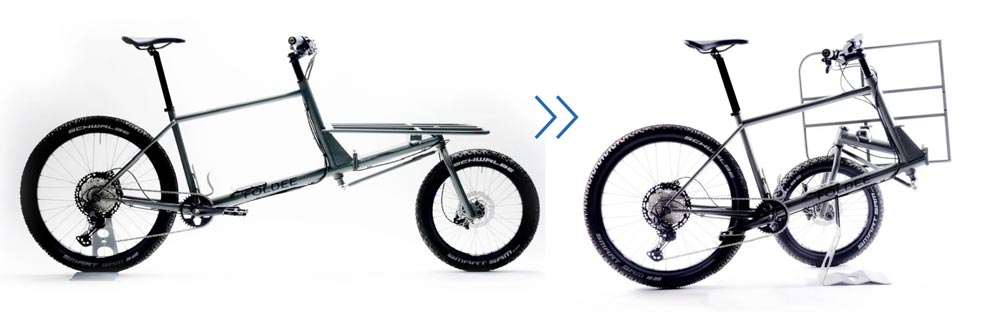
- The trick: A heavy-duty hinge ahead of the head tube folds the bike down to roughly a regular-bike footprint — about 30% less floor space, small enough to fit a bike box.
- The honour: Winner of the Eurobike Award 2026 in the Start-Up category.
- The catch: As shown it’s non-electric — unlike the e-versions Omnium and Monopole also sell.
What Foldee actually is
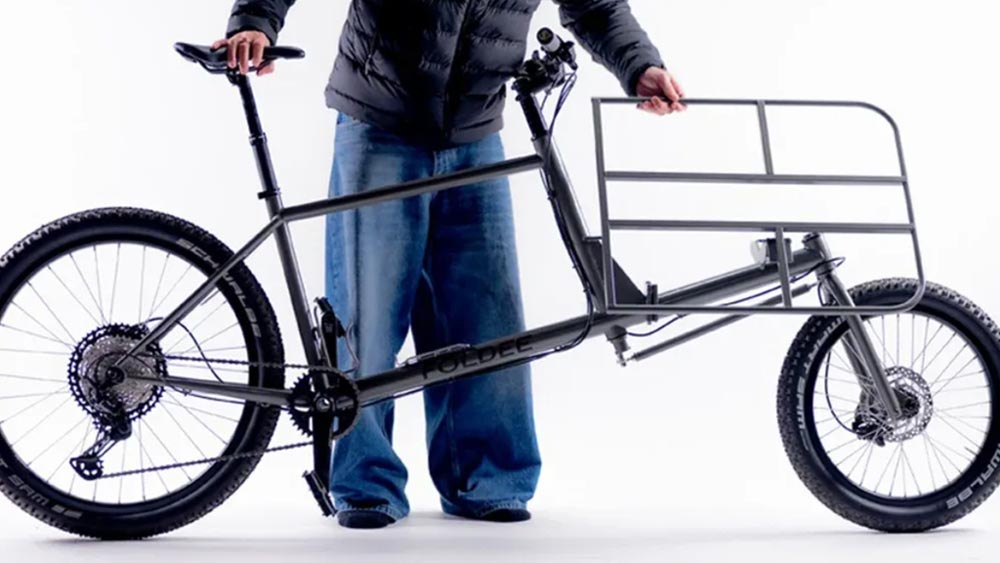
Foldee is a small Australian builder making a front-loading cargo bike with a genuinely novel feature: a big, burly hinge sitting just in front of the head tube lets the whole bike fold. Each one is handcrafted in a Brunswick workshop in Melbourne — a project that involves local builders Loop Cycles and Gutter Bikes — using recycled steel (4130 chromoly, per Foldee’s spec).
The layout is a mullet: a 20-inch front wheel under a flat cargo platform, paired with a 26-inch rear, on a steel frame with modern thru-axles and a clean 1× mechanical drivetrain. You ride it like any front-loader day to day; when you need to store or move it, you fold it and reclaim about a third of the floor space — compact enough to slide into a bike box for shipping or travel. It’s sold direct as a frameset or a complete bike, and as documented it is non-electric.
Why it won the Eurobike 2026 Start-Up Award
The Eurobike Award is in its 20th year and runs across ten categories, with a discounted Start-Up track for companies founded within three years. The jury’s verdict on Foldee is the whole story, and it’s refreshingly grounded.
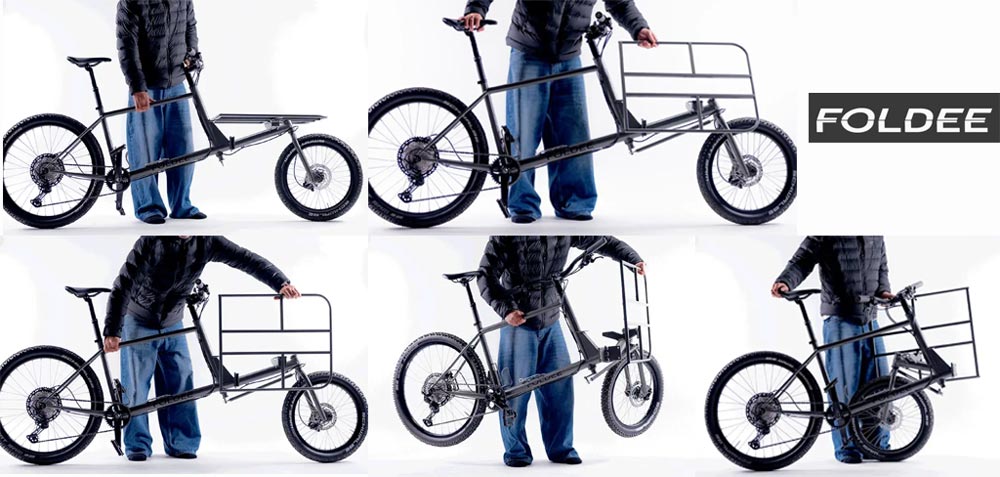
Rather than praising a spec, the judges liked that it rides like a normal bike — light to pick up, and nimble even with a load. One judge admitted surprise at how easily it steered fully loaded. Most of all they valued the core idea: a cargo bike that folds down to regular-bike size, which the jury called “good for people who have difficulties storing it at home.” Notably, the same jury flagged that the current folding mechanism still has room to improve — but said that didn’t change their verdict.
That balance matters. The award isn’t for a flawless product; it’s for cracking open cargo-bike ownership for the urban households that physically have nowhere to park a two-metre bakfiets. It’s the exact objection every dealer hears on the shop floor — “I’d love one, but I have nowhere to keep it” — engineered away.
There’s a bigger signal here too. Eurobike 2026 was a contraction: exhibitor numbers fell from roughly 1,500 in 2025 to about 800, with Bosch and Schwalbe sitting it out and the show moving to a biennial cycle. In a thinned field dominated by motors and gearboxes, a tiny analogue startup taking the Start-Up Award says something about where differentiation is heading — away from commoditized drivetrains and toward form-factor and real-world usability.
Key specs
From Foldee’s published geometry, its store, and press coverage:
- Frame: Recycled steel / 4130 chromoly (Atelier & Complete); titanium option
- Fold benefit: Folds to ~regular-bike size; ~30% smaller floor footprint; fits a bike box
- Hinge: Single heavy-duty hinge just ahead of the head tube
- Unfolded length: 2,130 mm (~2.13 m)
- Wheelbase: 1,600 mm
- Wheels: 20″ front / 26″ rear (mullet)
- Front cargo platform: 530 mm wide × 650 mm long
- Axles / hanger: 12×100 mm front, 12×148 mm rear, disc-only; UDH hanger
- Geometry: 70° head angle, 75° seat angle, 60 mm BB drop
- Standards: 73 mm BSA threaded BB, 31.6 mm seatpost
- Payload: Customised per build (small-batch, not a single standardised figure)
- Indicative RRP: roughly A$6,500–9,250 across the Titanium, Complete and Atelier options (trade/dealer pricing differs and isn’t public)
The innovation: a fold that doesn’t soften the cargo platform
Folding bikes usually trade stiffness for compactness. Foldee inverts that. The frame is engineered as a strong cargo platform first, with the hinge integrated into that structure rather than bolted on afterwards, so it stays rigid under heavy front loads. Three things make it credible as a daily workhorse rather than a gimmick:
- A single, heavy-duty hinge placed where it does the most good (ahead of the head tube), leaving the rest of the front end solid.
- Universal, serviceable standards — UDH hanger, BSA BB, common thru-axles — so a normal workshop can maintain it for years.
- Real-world refinement — years of riding and prototyping in Melbourne, not just CAD.
Foldee vs Omnium vs Monopole: how it’s different
Compact front-loaders already exist and they’re excellent. Omnium (Denmark) and Monopole (Switzerland) both shrank the cargo bike into something that rides like a normal bike. Foldee sits in the same sporty, steel, platform-rack family — but adds the one thing neither rival does: it folds.

| Foldee | Omnium Cargo V3 | Monopole No O1 | |
|---|---|---|---|
| Origin | Handcrafted, Melbourne, Australia | Made in Denmark | Designed in Switzerland, made in France |
| Frame | Recycled / 4130 chromoly; Ti option | Double-butted chromoly; Ti option | Aerospace-grade steel |
| Folds? | Yes — hinge, ~30% smaller footprint | No | No |
| Front layout | Platform over 20″ front wheel | Platform; 20″ front / 700c rear | Platform / shopper rack |
| Drivetrain | 1× mechanical | 1×11 or Alfine 8 belt | Pinion gearbox + Gates belt steering |
| Total payload | Custom per build | 175 kg incl. rider (75 kg front rack) | 160 kg |
| Weight | Not published | ~20 kg (M, non-electric) | Not published |
| Electric option | None announced | Yes — E-Cargo (Shimano EP8) | Yes — electric or “bio” |
| RRP | ~A$6,500–9,250 (indicative) | By configuration | By configuration |
The honest read: if you never need to store or transport the bike compactly, an Omnium or Monopole is a superb fixed-length front-loader — Omnium with a proven 75 kg front-rack rating, Monopole with its sealed Pinion gearbox and belt steering. The moment storage or multi-modal transport is the constraint, Foldee solves a problem the others simply don’t. See where each fits in the wider field in our cargo bike brands directory.
The trade view: four things dealers and distributors should take from this
This is where Foldee gets interesting beyond the press release.
1. The hinge is the warranty question — get EN 17860 data on it. A structural fold point on a cargo frame is exactly the kind of stress concentration that fails after years in the field, not in a four-week demo. The jury itself noted the mechanism has room to improve. Under EN 17860, commercial-use fatigue testing now demands 200,000 pedalling cycles (double the private threshold), and the Babboe recall — 22,000+ units over hairline frame cracks — is the cautionary tale for anyone who skips third-party fatigue lab reports. Before stocking or importing, ask specifically how the hinge is fatigue-tested and certified. A small-batch builder may not have that paperwork yet.
2. “Folds to bike-box size” is a freight advantage, not just a lifestyle one. A fixed 2.1 m front-loader is dimensional-weight murder to ship and store. A bike that packs into a standard bike box cuts inbound freight, warehousing cube, and return-logistics cost — a real line-item benefit for distributors moving product across the EU or North America. Factor it into landed cost, not just shelf appeal — the kind of thing our B2B procurement & TCO guide is built to model.
3. Position it as a halo piece, not a fleet or family volume SKU. Non-electric, handmade, small-batch, premium-priced — this is an enthusiast and small-space-dweller product (think the Radavist/bikepacking buyer), not a school-run e-cargo or a delivery fleet bike. Most 2026 demand wants e-assist, and over half of EU e-cargo volume is commercial. Stock Foldee as a destination/credibility piece; point families to e-assist options like those in our 2026 family e-cargo picks.
4. The durable opportunity may be the concept, not this one bike. “Folding front-loader” is a thin field with an award now attached to it. For brands and OEMs scanning the manufacturer landscape, the strategic signal is that storage-solving form factors are winning jury attention in a reset-era market — and a hinge-fold platform is replicable. Foldee has first-mover PR; whether it has a defensible moat is the open question.
Company background and business model
Foldee is an early-stage, craft-led operation. Instead of mass production it runs a direct-to-consumer, small-batch model across three tiers: the Atelier Frameset (the original, handmade Melbourne chromoly), the Titanium Frameset (lighter, corrosion-proof, Taiwan-made tubing), and the Complete Cargo Bike (ready-to-ride chromoly build). Its stated mission is sustainable commuting and better urban mobility through design — which lines up with the recycled-steel construction and the storage-first concept that won the award.
Be clear-eyed about stage: Foldee only just launched, its storefront still carries preliminary product pages, and pricing and wider availability weren’t locked at award time. This is a young company with a strong idea and an industry endorsement — not yet a volume supplier.
FAQ
Is the Foldee an electric cargo bike? No. As documented it’s a mechanical (non-electric) folding cargo bike, with no e-assist version announced. Both Omnium (E-Cargo, Shimano EP8) and Monopole offer electric builds; Foldee currently does not.
How small does it fold? It folds down to roughly the size of a regular bike — about 30% less floor footprint — compact enough to fit a bike box. Exact folded dimensions aren’t published yet.
What did it win at Eurobike 2026? The Eurobike Award 2026 in the Start-Up category, for making cargo-bike mobility accessible to people with limited storage space.
What’s it made of? Recycled steel / 4130 chromoly, handcrafted in Melbourne, with a titanium frameset option.
How much can it carry? Because it’s custom-built in small batches, payload is specified per build rather than as one standard number. For reference, comparable front-loaders rate ~160–175 kg total system weight (Monopole 160 kg; Omnium 175 kg incl. rider).
Is it certified to EN 17860? Not confirmed publicly. Given the structural hinge, any dealer or distributor should request specific EN 17860 fatigue-test data before committing — see our cargo bike manufacturing guide.
The bottom line
Foldee won the Eurobike 2026 Start-Up Award by refusing the compromise the category had normalised: that a real hauler has to be big and stay big. By engineering a fold that still rides and carries like a proper front-loader, it makes cargo ownership realistic for the exact urban homes that need it most. For the trade, it’s less a volume product than a signal — that in a reset-era market, storage-solving design is what’s winning attention. Watch for an e-assist option, confirmed payload ratings, EN 17860 certification, and supply that scales beyond small-batch Melbourne production.
Related on cargobikehub.com:
- Cargo bike brands directory
- Cargo bike manufacturing & EN 17860 compliance
- B2B cargo bike procurement & TCO guide
- Cargo bike manufacturers directory
Sources: Eurobike Award 2026 winners (eurobike.com) · Foldee (foldee.cc) · The Radavist (1 Jun 2026) · Omnium (omniumcargo.com) · Monopole (monopole.cc).
Editorially independent. cargobikehub.com has no commercial relationship with the operators named. Pricing, subsidy and policy figures are drawn from operator statements and public sources current as of June 2026; subsidy windows and rules change frequently — verify locally before acting. This is not financial advice.
Table of Contents
- The 30-second version
- What Foldee actually is
- Why it won the Eurobike 2026 Start-Up Award
- Key specs
- The innovation: a fold that doesn’t soften the cargo platform
- Foldee vs Omnium vs Monopole: how it’s different
- The trade view: four things dealers and distributors should take from this
- Company background and business model
- FAQ
- The bottom line


