

Most buyers don’t fail because they chose the wrong cargo bike supplier.
They fail because they negotiated the wrong things in the wrong way.
On paper, everything looks clear: price, lead time, specifications. But once the order starts, reality shifts. Delivery slips, communication slows down, and small misunderstandings compound into expensive problems.
Negotiation, in this context, is not about pushing harder.
It’s about understanding how Chinese suppliers actually operate — and aligning yourself with that system.

1. Delivery Time Is Not a Commitment — It’s a Moving Target
The first misunderstanding usually happens around delivery.
Many buyers treat lead time as a fixed promise. In practice, it behaves more like a probability.
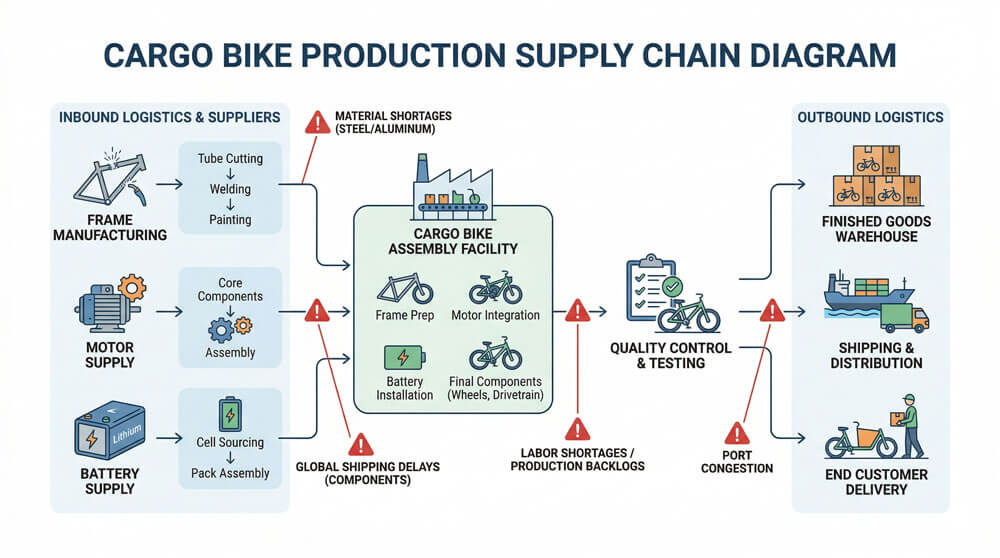
Even under stable conditions, delays are common. Component supply, especially for motors, batteries, and frames, fluctuates constantly. Industry data shows that production timelines can easily shift by 10–30% depending on upstream dependencies.
The mistake is being too transparent too early.
If you reveal your real deadline, especially when tied to a fixed container booking, you remove your own buffer. The supplier will optimize toward that date, not toward reliability.
Experienced buyers quietly do the opposite. They communicate a timeline that is slightly tighter than their real requirement. This is not about playing games — it is about absorbing uncertainty before it becomes a crisis.
Once production starts, time stops being negotiable.
So the only moment you control risk is before the order is confirmed.
2. The Person You Talk To Can Decide the Outcome
Two companies can buy from the same factory and have completely different experiences. What changes is not the production line, but the person managing the order.
In many Chinese e-bike companies, the salesperson is not just selling. They are coordinating internally, pushing production, and translating your expectations into factory actions. If that person is proactive, problems are surfaced early. If not, delays are discovered when it is already too late.
This becomes more complicated because sales turnover is high. The person replying to your first inquiry on platforms like Alibaba might be new, undertrained, or simply not responsible for your project long-term.
If communication feels unclear or passive, it is often not a company problem but a contact problem. Buyers who understand this do not hesitate to re-enter the same company through a different channel. Reaching out via official websites or professional networks often leads to more experienced staff or even management-level attention.
Negotiation, in this sense, is also about choosing who represents the supplier in your project.
3. If You Don’t Show Expertise, You Will Be Treated as Price-Driven
Suppliers quickly categorize buyers. This happens within the first few exchanges.
If your questions stay at surface level, the assumption is simple: you are comparing prices, not building a product. And once that assumption is made, everything that follows — from quotation to production priority — is optimized accordingly.
The only way to change that dynamic is to demonstrate that you understand how the product is actually made.
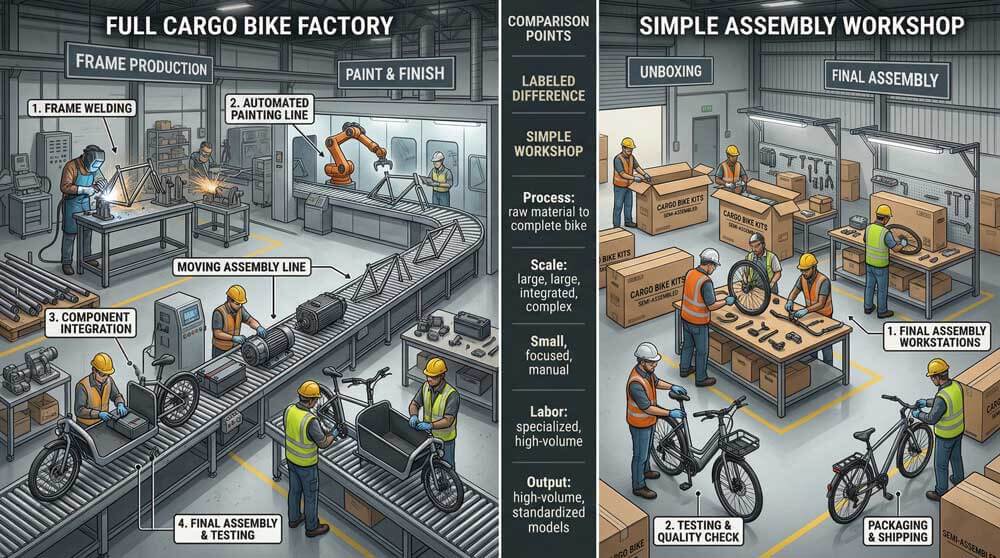
For cargo bikes, this goes beyond specifications. The critical point is the frame. It is the most complex and time-sensitive component in the entire build. Many suppliers present themselves as manufacturers, but in reality, they assemble bikes using externally sourced frames.
This distinction matters because it determines how much control they have over delivery.
A useful approach is to ask for verifiable details rather than general assurances. Business licenses, production permits, and real factory footage provide more insight than polished catalogs. Comparing addresses between assembly sites and frame production locations often reveals whether the supplier controls its core process or depends on another layer.
The goal is not to challenge the supplier aggressively, but to make it clear that you are capable of understanding the answers.
That alone changes how seriously your project is treated.
4. Price Negotiation Only Works When You Change the Context
When order volume is small, pushing for a lower price rarely works in isolation.
From the supplier’s perspective, small orders already carry higher relative costs: setup, coordination, and risk. If the only variable you offer is price pressure, the negotiation quickly reaches a dead end.
What changes the outcome is shifting the conversation from immediate margin to future value.
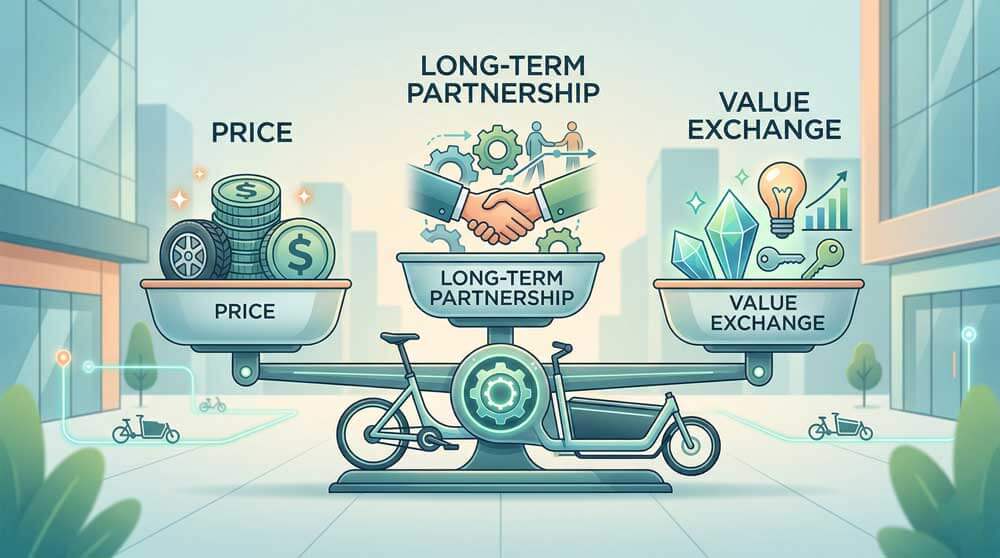
Chinese suppliers respond strongly to signals of growth. This does not mean making unrealistic promises. It means showing that your business has a direction — a market, a channel, or a positioning that could scale.
There is also another layer that is often underestimated: non-monetary value.
Many Chinese manufacturers lack localized content. They have products but struggle to present them effectively in Western markets. If you can offer real-world usage footage, authentic customer scenarios, or even exposure through your own channels, you are no longer negotiating as a small buyer. You are contributing something the supplier cannot easily produce internally.
At that point, price becomes part of a broader exchange rather than the only variable.
5. Pressure Works, But Only When It Feels Real
Comparing suppliers is necessary, but the way it is communicated determines whether it creates leverage or resistance.
If price comparison is framed as confrontation, suppliers become defensive. If it is framed as a decision process, it creates a different kind of pressure.
Buyers who handle this well do not hide the fact that they are evaluating multiple options. At the same time, they signal clear intent toward the supplier they prefer. Sharing selected quotations, without turning it into a direct challenge, shows both seriousness and transparency.
This approach works because it mirrors how suppliers themselves evaluate customers.
They prioritize those who appear committed, not those who simply push harder.
6. Inside the Company, Priority Is Not Always Formal
One structural reality is often overlooked by Western buyers: many Chinese cargo bike companies operate with very flat hierarchies.
This means decisions are concentrated.
If your project remains at the sales level, it competes with others based on routine processes. But once management becomes aware of it, the dynamic changes. Internal coordination becomes faster, and production attention increases.
This is not about bypassing the salesperson. It is about ensuring that your project is visible at the level where priorities are actually set.
In practice, this can happen naturally through ongoing communication. But experienced buyers often make a deliberate effort to establish contact with senior staff early, especially for projects that require consistency over time.
7. Negotiation Is Also About Relationship Signals
A purely transactional approach rarely produces the best outcome.
Chinese business culture places strong emphasis on reciprocity. This does not mean giving up your position. It means recognizing that cooperation improves when both sides feel invested.
If every interaction is rigid, communication tends to become minimal. The supplier does what is required, but not much more. When issues arise — and they always do — resolution depends entirely on formal obligations.
On the other hand, when there is a balance between firmness and flexibility, something changes. The salesperson becomes more proactive. Internal coordination improves. Problems are solved with more effort.
In cargo bike projects, where delays, adjustments, and after-sales issues are common, this difference becomes visible very quickly.
8. Seeing the Factory Changes How You Negotiate
Visiting China is still one of the most effective ways to reduce uncertainty.
It is not just about verifying capacity. It is about understanding how the operation actually works — the scale, the organization, and the level of control over production.
More importantly, it changes the nature of commitments. Agreements made face-to-face tend to carry more weight, not because they are formalized differently, but because they are embedded in a direct relationship.
For buyers planning long-term cooperation, this step often prevents problems that would otherwise only appear after multiple orders.
9. The Real Constraint Is the Supply Chain Behind the Supplier
One of the most common blind spots is assuming that a supplier’s capability is fully internal.
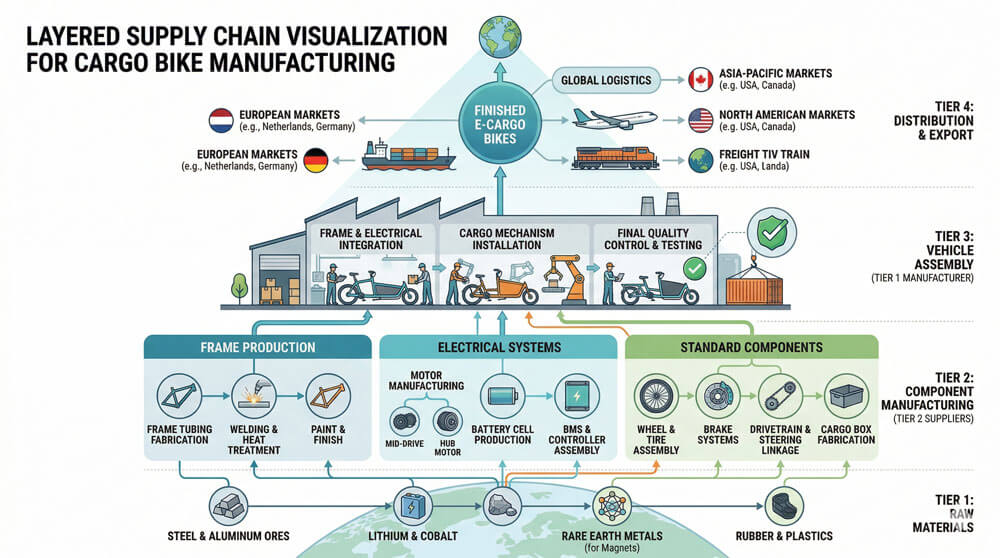
In reality, many cargo bike manufacturers depend on a network of partners. Motors, batteries, and especially frames often come from specialized suppliers. Each layer adds complexity, and each dependency introduces risk.
If your project requires strict delivery control, understanding this structure is essential. A supplier that appears reliable on the surface may still be vulnerable to delays if its upstream partners are not aligned.
This is why negotiation should extend beyond price and lead time. It should include a clear understanding of how much of the production process the supplier actually controls.
10. There Is No Perfect Supplier — Only the Right Fit
Many buyers approach sourcing with the idea that there is a best supplier waiting to be found.
In practice, that expectation creates unnecessary friction.
Suppliers are not universally good or bad. They are suited to different stages and priorities. Some offer flexibility, others consistency, and others scale.
The goal of negotiation is not to extract the maximum concession.
It is to align expectations so that both sides benefit from the same outcome.
When that alignment exists, delivery improves, communication becomes smoother, and long-term cooperation becomes possible.
Where This Is Going Next
As cargo bike demand grows, especially in urban logistics, the balance of power between buyers and suppliers is shifting.
More manufacturers are building their own brands. Margins in OEM production are tightening. At the same time, regulatory requirements in Europe and other markets are becoming stricter, increasing the importance of compliance and technical capability.
In this environment, negotiation will rely less on price pressure and more on understanding systems — production systems, supply chains, and market positioning.
Buyers who adapt to this will not just get better deals.
They will build more reliable supply networks.
Haven’t found the right manufacturer for your cargo bike brand? Explore our cargo bike manufacturers list and supply chain information. More cargo bike industry trends, please keep following CargoBikeHub!
Table of Contents
- 1. Delivery Time Is Not a Commitment — It’s a Moving Target
- 2. The Person You Talk To Can Decide the Outcome
- 3. If You Don’t Show Expertise, You Will Be Treated as Price-Driven
- 4. Price Negotiation Only Works When You Change the Context
- 5. Pressure Works, But Only When It Feels Real
- 6. Inside the Company, Priority Is Not Always Formal
- 7. Negotiation Is Also About Relationship Signals
- 8. Seeing the Factory Changes How You Negotiate
- 9. The Real Constraint Is the Supply Chain Behind the Supplier
- 10. There Is No Perfect Supplier — Only the Right Fit
- Where This Is Going Next


