

Yes — a cargo bike built to today’s standards and handled correctly is a safe way to carry children, and for short urban trips it is often safer than the car it replaces. But “safe” is not a slogan; it is a set of specific, knowable risks that good engineering and an honest seller can each address. For retailers and brands, that distinction is the opportunity: in a product that carries children, the seller who can prove safety and talk about it honestly owns the cheapest, most durable moat in the category — trust.
This article answers the question parents actually type, then turns it into a B2B advantage. It pairs with what makes a family cargo bike sell and family cargo bike types.
The honest answer: safe, with three real risks

A modern family cargo bike is engineered to carry passengers, and the data on car-trip replacement (around half of e-cargo journeys replace a car, per our market analysis) means many of these trips swap a higher-risk mode for a lower-risk one. The risks that remain are specific, not vague:
- Frame integrity. A cargo bike carries 200–300 kg of load and passengers; a weak frame is the one failure that matters most. This is the Babboe lesson — concealed hairline frame cracks led to a recall of roughly 22,000 bikes and a Dutch criminal investigation, detailed in our manufacturing mistakes guide.
- Battery fire. Cargo bikes use larger, higher-capacity batteries, so an uncertified pack is a disproportionate hazard. The fix is certification (below) and safe-charging guidance.
- The physical handling moment. The single most common real-world incident is not a crash — it is the bike tipping while a parent loads a child onto a stand. We cover this standstill-stability problem, and the wide locking stands that solve it, in what makes a family cargo bike sell; three-wheel trikes remove it entirely, as explained in family cargo bike types.
Name these three honestly and you have already told a buyer more than most retailers will.
The standards that now define “safe”
Until recently there was no purpose-built European cargo bike standard; manufacturers leaned on EN 15194, the e-bike standard never designed for a 300 kg load. That gap closed with EN 17860:2024 “Carrier Cycles,” a seven-part series developed by CEN/TC 333/WG 9 specifically for cargo cycles, ratified from 2024 onward and replacing reliance on the older German DIN 79010, as documented by ACT LAB and SGS. It covers single- and multi-track bikes, heavy cargo bikes, trailers, passenger-transport modules, and an electrical part, with batteries held to EN 50604-1.
On the electrical side, the benchmark is UL 2849, which tests the whole e-bike electrical system — battery, charger, motor, controller, wiring — as an integrated unit, often paired with UL 2271 for the battery pack (UL Solutions). This is no longer optional in key US markets: New York City has mandated third-party certification since 2023, and California’s battery law and other jurisdictions have followed, so that by 2026 non-certified e-bikes are being pulled from shelves. Shipping any battery also requires UN 38.3 transport testing. Certifying one e-cargo model is not trivial — industry labs put it at roughly $35k–$80k for the EU and $60k–$150k for a US-ready bike — which is exactly why a seller should treat a brand’s certifications as hard-won proof, not marketing. (New EU rules also reshape battery safety and repair — see the removability section of the EU battery passport guide)
The benchmark has moved: from bike rack to car seat
Here is the shift that should reframe how every retailer and brand talks about child safety: parents — especially at the premium end — no longer measure a cargo bike against a bicycle rack. They measure it against a child car seat. That is a different bar entirely, and the products winning design juries reflect it.
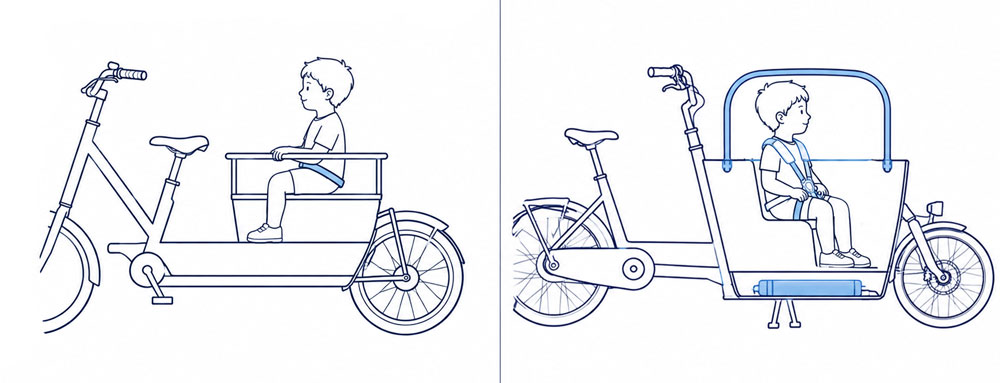
The clearest evidence is Ca Go, whose FS Life / FS 200 made the passenger “safety cell” its core proposition and won the Red Dot Award: Product Design 2025 for the box’s design. The features read like automotive engineering, not bike accessories: a five-point harness anchored directly into the frame (not bolted to a removable bench), a child-seat interface compatible with ISOFIX/ISO 13216, an F1-cockpit-inspired “Ortho” safety collar that limits head and neck movement in an impact, an impact-absorbing EPP cell with metal side-impact bars, and dual batteries sunk into a floor “battery well” that drops the centre of gravity far lower than a rack seat ever could. Ca Go also commissioned an independent, automotive-style crash test — a first for the category — explicitly to answer the question “why can’t a child be as safe in a cargo bike as in a car?”
Why this matters commercially is the contrast. When the ADAC and Swiss insurer Basler crash-tested conventional cargo bikes, the results were ugly: on a simple wooden-box bakfiets, the folding bench tore from its mounting and the belted dummies fell out of the cabin, and on another the belt itself failed, as reported in detail. The gap between “safety cell” and “bench with a belt” is now visible, tested, and publicised. Most longtail rear seats and most trike boxes still sit at the “add a guardrail” end of that spectrum.
For a B2B buyer the implication is direct, and it is not about reassuring parents — it is about range strategy. If your line-up tops out at a padded bench with a guardrail, you have quietly ceded the entire premium, safety-led tier to brands that engineered a cell. You don’t need every model to be a Ca Go, but you need to know where each sits on that spectrum, sell it honestly (next section), and make sure your premium SKU has a credible answer when a high-end parent asks the car-seat question. Watching where the design juries point — Red Dot 2025 also recognized child “passenger capsules” from KETTLER and others — is a cheap way to read where premium demand is heading next.
Turn safety into your moat: out-prepare the buyer

Here is where most sellers leave the biggest opportunity on the table. A family buying a child-carrying vehicle is anxious and under-informed, and they remember who made them feel safe. The winning seller anticipates what the buyer doesn’t yet know to ask:
- Ship safety and usage documentation as standard — and demand it from the factory. Build it into the purchase order: require your OEM/ODM partner to supply clear paper and digital safety and usage guides, in the buyer’s language, covering load limits, child-restraint use, charging, and pre-ride checks. This is cheap at the factory and priceless at the kitchen table. A buyer who is handed a proper manual trusts the bike — and you — more than one left to figure it out from YouTube.
- Name certifications openly, the way the best brands do. Tern publishes exactly which standards each bike meets and why they matter (Tern’s certifications page). Copy that transparency: show the marks, link the test directory, let the buyer verify. Hidden compliance reads as no compliance.
- Tell the truth about every model’s trade-offs. There is no perfect cargo bike — only the right one for a specific family. A box bike is heavy and needs storage; a longtail asks a nervous rider to balance; a trike is wide and doesn’t lean; a budget value bike trades a premium motor for price. Say so. The honest “this one isn’t for you, but that one is” earns the referral that three glossy spec sheets never will.
More ways to make safety your reputation engine
The factory documentation and honesty are the foundation; build on them:
- A pre-delivery safety check and handover ride. Don’t hand over a boxed bike. Assemble, inspect, and give a 15-minute loaded test ride covering the stand, the brakes, and loading a child. The handover is the single highest-trust moment you get.
- A “first 100 km” care card. Bolt-check intervals, charging do’s and don’ts, what a healthy frame and battery sound and feel like. It signals you expect the bike to last — and to be checked.
- Serial traceability and a recall promise. Record every serial against the buyer. If a component is ever recalled, you can reach owners in a day. After Babboe, parents notice who can do this.
- Test rides and loaners to de-risk the decision. Anxiety, not price, kills more family sales than anything. Letting a nervous parent load their own child onto the bike in your forecourt closes more deals than any discount.
- Train staff to answer “is it safe?” with specifics. “Totally safe!” reassures no one. “It’s certified to EN 17860 and UL 2849, the stand locks wide so it won’t tip when you load the second child, and here’s the restraint” — that converts.
None of this is expensive. All of it compounds into the one thing a child-carrying purchase runs on: word of mouth at the school gate.
Why this wins, commercially
The nervous, first-time parent is the largest under-converted segment in the family category, and they buy on trust before spec. Honesty and preparation also insure you against the category’s worst-case event: the Babboe collapse showed that in a child-carrying product, a single concealed safety failure doesn’t dent a brand — it ends it. The seller who documents, certifies visibly, and speaks plainly is both converting more of the anxious majority and building the reputation that survives an industry scare.
The bottom line
Are cargo bikes safe for kids? Yes — when they are built to EN 17860 and UL 2849, fitted with a stable stand or three wheels, and handled with a little knowledge. The brands and retailers who will own this market are the ones who treat that “little knowledge” as their job: factory-made safety guides, openly named certifications, and honest, model-by-model truth-telling. In a product that carries children, trust is the product.
This is a sensitive topic for any parent. For the engineering side, see cargo bike manufacturing mistakes and the B2B procurement guide. Continue the cluster: Family cargo bike types · What makes a family cargo bike sell · The school-run bike · Family Cargo Bike pillar guide · cargo bike user insights.
Editorially independent. cargobikehub.com has no commercial relationship with the operators named. Pricing, subsidy and policy figures are drawn from operator statements and public sources current as of June 2026; subsidy windows and rules change frequently — verify locally before acting. This is not financial advice.


