

The International Cargo Bike Festival ran 12–13 October 2026 at Jaarbeurs Utrecht with 44 exhibitors and roughly 600 visits from around 36 countries. It is deliberately small — a working conference with a test track attached, rather than a mass consumer expo. The floor split between heavy-duty logistics machines and compact folding bikes, with components, batteries, trailers and parking systems filling the space between them.
If you judge a trade show by footfall, this one looks like a rounding error. Eurobike counts its visitors in the tens of thousands. ICBF counted about 600 visits across two days.

Judge it by who those 600 were and the picture inverts. This is the only European event where the cargo bike is the entire agenda rather than a hall at the back, and the people walking the floor are fleet operators, municipal buyers, importers and federation staff. CargoBikeHub’s read of the 2026 exhibitor roster is that ICBF has quietly become a component and systems show wearing a festival’s name: at least 17 of the 44 exhibitors sold no complete bike at all, offering drivetrains, batteries, brakes, wheels, tyres, boxes, trailers, locks, load securing or parking instead.
The International Cargo Bike Festival by the Numbers
The event took place at Jaarbeurs in Utrecht on 12 and 13 October 2026, its third consecutive year in the city, organised by Jos Sluijsmans and Tom Parr under Fietsdiensten.nl. Entry was free.
Attendance figures vary slightly by source. eBikes International reported about 600 visits over two days from 36 countries, while Ciclosfera reported more than 600 visitors and 37 nationalities. The gap is trivial, and both accounts agree the organisers framed the event around visitor quality rather than volume. Treat roughly 600 and mid-30s country count as the working figures.
The exhibitor number is firmer: the official exhibitor list carried 44 names, sorted into five categories — Festival, For Business, Personal Mobility, Tech and Trailers. Visitors booked one-to-one meetings through a platform called Conversation Starter, and exhibitors pitched from the main stage in two-minute rounds, three times across the two days.
That pitch format tells you what kind of show this is. Nobody gets a keynote slot to launch a flagship. You get 120 seconds and a stand number.
Vehicles and Platforms: The Barbell on the Floor
The complete-vehicle exhibitors clustered at two opposite ends, with very little in the middle. One group builds bigger and heavier for commercial payloads; the other builds smaller and foldable to solve storage. Almost nobody showed a conventional mid-size family longtail, which is the segment most volume brands actually sell.
| Exhibitor | Country | What they showed |
|---|---|---|
| Kleuster | France | Utility cargo bikes co-developed with Renault Trucks; the Kleuster 350 (launched June 2025) rated to 300 kg payload, 80 km range, 18% gradient at full load |
| VSC.BIKE | Germany | Boxloader and Workloader fleet bikes, built in Allstedt with mainly German and European components |
| Santos Bikes | Netherlands | Patrol Bike for police and municipal enforcement; custom-branded cargo bike, built near Amsterdam |
| FOLDEE | Australia | Folding cargo bike on a patented double-hinge frame, modular recyclable steel; EUROBIKE Start-Up Award 2026 |
| GoLo | Netherlands | Cargo platform with a kneeling system that lowers the load bed, plus a linear hybrid drive |
| Veloe | Italy | multi and multi lungo family cargo bikes, designed and assembled near Milan |
| minica | Taiwan | Compact cargo trike with a dual-motor module and low centre of gravity |
| LUXMEA | Europe | ODM/OEM e-cargo platforms; claims 550,000+ units in use across Europe since 2008 |
| TXED Bikes | China | OEM and custom cargo and commuter builds from Tianjin; ISO 9001:2015 and BSCI certified |
| Flevobike Technology | Netherlands | Recumbents, velomobiles and in-house product development and prototyping |
| Atmose Bikes | — | E-bike design, manufacture and service for export markets |
| Ebike4Delivery | Netherlands | Delivery fleet programmes running in 300+ cities, serving 1,700+ businesses |

Kleuster is the clearest statement of the heavy end. A 300 kg payload with an 18% gradient capability at full load is not a bicycle specification — it is a light commercial vehicle specification, and the Renault Trucks co-development says exactly which industry it is benchmarking against.
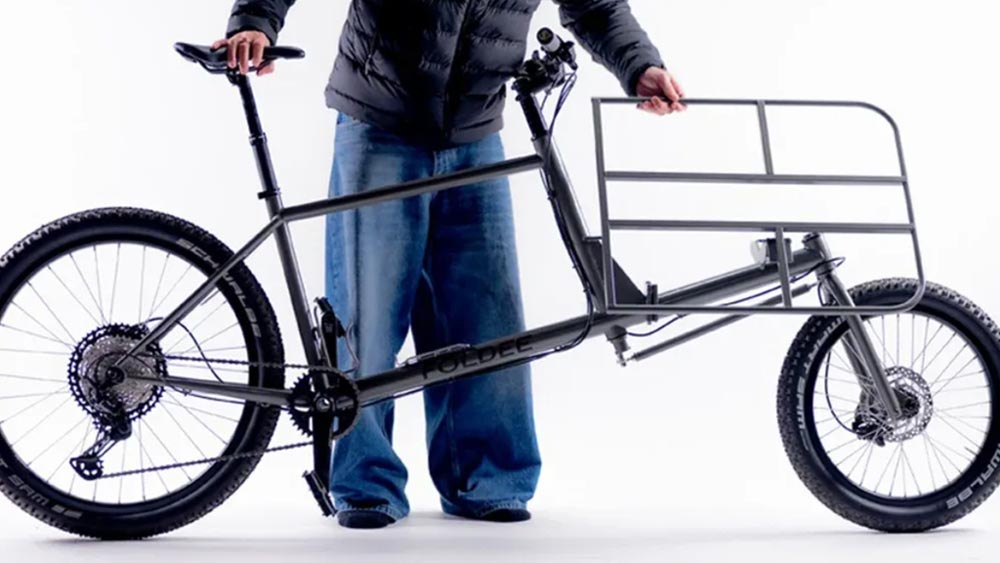
FOLDEE argues the opposite case. Its pitch is that the thing stopping cargo bike sales is not range or payload but the fact that the bike does not fit anywhere, so it built the frame around a hinge. Taking the EUROBIKE Start-Up Award in 2026 suggests the judges agreed that storage is the live problem.
Components, Batteries and Kit: Where the Show Got Serious
The more informative half of the floor was the supplier side. These are the firms that decide whether a cargo bike is a scaled-up e-bike or a purpose-built vehicle, and most of them have stopped adapting e-bike parts and started engineering cargo-specific ones — the same shift CargoBikeHub tracks across its directory of cargo bike component suppliers. Note how many lead with a load rating, a certification or a warranty term rather than a feature.
| Exhibitor | Country | Product focus |
|---|---|---|
| CIXI | France | PERS chainless pedalling system, 3.5 kg, up to 185 Nm, regenerative pedalling adding up to 25% range, reverse on 3+ wheels |
| AX-Drive | South Korea | M4 in-wheel cargo motor, 36 V/48 V, up to 110 Nm and 2 kW peak |
| Okawa | China / Netherlands | Mid-drive and hub motors with a 4-year warranty that includes commercial use |
| Pendix | Germany | eDrive and gDrive retrofit systems built in its own German factory |
| TFREE | Germany | AI-managed e-drive, chainless drive, and a modular chassis built to EN 17860 |
| Infinite Battery (Gouach) | France | Fireproof, modular, connected battery repairable with a screwdriver in under 10 minutes; claims compatibility with 90%+ of e-bike brands |
| RIDEREVER | Taiwan | Cargo Series braking systems, DIN 79010 load tested |
| Alligt | Netherlands | Injection-moulded and CNC-machined wheels engineered for cargo loads |
| allsafe | Germany | Load securing systems carried over from automotive and aerospace practice |
| Suomi Tyres | Finland | Routa Cargo winter tyre with Finnish hardened steel studs and reinforced casing |
| HYPABOX | Germany | Modular commercial cargo box systems, made in Cologne |
| zemmi | Germany | Modular cargo bike trailer with 4.2 m³ load volume, no driving licence required |
| Bibby Bikes | Austria | Four-wheel flatbed trailer, 160 × 80 cm bed, 200 kg payload, overrun brake, turntable steering |
| TMD Locks | Netherlands | Keyless electronic chain lock with alarm, ART 2 certified |
| Ventisit | Netherlands | Ventilated cushions and cargo box floor mats |
| LAIONS | Netherlands | OWSYM safety unit combining cameras, sensors and edge AI for light electric vehicles |
| BOUT | Netherlands | Modular public parking converting one car space into four cargo bike spaces |
Two certifications in that table deserve a closer look, because they are not the same answer. TFREE markets a chassis built to EN 17860, the European carrier cycle series whose first parts landed in 2024. RIDEREVER markets brakes passed to DIN 79010, the older German cargo bike standard. DIN itself notes that DIN EN 17860-2:2025-06 only partially replaces DIN 79010:2020-02, so both claims are legitimate today — but they are not interchangeable, and a buyer comparing two spec sheets needs to know which document each number came from. If you are writing a specification, the practical reading is covered in CargoBikeHub’s breakdown of cargo bike brakes.
The Okawa warranty is the other quiet signal. A four-year term that explicitly survives commercial use is a supplier accepting duty-cycle risk it would previously have excluded, and it reprices the whole electric cargo bike motor power conversation for fleet buyers.
The Rest of the Roster
Fourteen further exhibitors filled out the floor without published product detail: Broadcast Bike, which filmed the main stage from a bike-mounted studio; Cathy Tuttle; Cycling Cities; De Fietskoerier Utrecht; Dutch Cycling Week; the ICBF Shop; Jaim & Zo; LEVA-EU; PENDLR, powered by Kruitbosch; RAD15; Remco Tools; Sanne Paul, the festival photographer; Townmaking; and Twotone. CycloLogica, an Italian cycle logistics operator, also exhibited alongside minica.
Several exhibitors shared stands — CIXI with GoLo, zemmi with HYPABOX, TFREE with LUXMEA, Veloe with Twotone, minica with CycloLogica. For a show this size, co-exhibiting is not cost-cutting so much as supply chain signalling: the pairs are usually a platform and the system going into it.
What the Exhibitors Had in Common
Strip away the categories and four shared characteristics show up across almost every stand.
Nearly all of them manufacture in their stated market or own their tooling. Kleuster, VSC.BIKE, Santos, Veloe, HYPABOX, Pendix, Suomi Tyres and allsafe all lead with domestic or in-house production. For an industry whose volume product is assembled in Asia, that is a positioning choice aimed squarely at fleet and municipal tenders, where provenance and lead time survive procurement scrutiny better than unit price.
They sell to organisations, not households. Police forces, councils, parks departments, courier operators and facilities managers recur throughout the exhibitor copy. Even the family-oriented brands framed the value in storage and daily utility terms rather than lifestyle.
They specify against loads and standards instead of features. Payload in kilograms, torque in newton-metres, gradient at full load, DIN and EN references, ART certification, warranty length including commercial use. This is the vocabulary of procurement, and its spread across the floor is the single clearest sign of where the sector is heading.
And an unusual number are solving the problems that sit around the bike rather than in it — parking, trailers, load securing, locks, winter traction, box systems, cushions. The bike itself is treated as largely solved. What is not solved is everything that has to happen before and after the ride.
The Programme: Batteries, Mechanics and a Wider Map
The conference ran harder on policy and infrastructure than on product. Dr Frauke Behrendt of Eindhoven University of Technology opened with a keynote on battery-as-a-service drawn from two-wheeler electrification in Nairobi. Annick Roetynck of LEVA-EU ran a side session on the Dutch LEV framework and the EU Battery Regulation, and returned with Paul Timmer of Townmaking Institute on the eBike Battery Passport — a topic CargoBikeHub has tracked in its work on the EU battery passport for cargo bikes.
Ties van Dijk of Shimano Europe Group presented on cycle mechanic standards and careers, addressing the mechanic shortage directly. That session matters more than its slot suggests, because a service network with nobody qualified to staff it is the constraint behind the broader cargo bike serviceability gap.
The rest of the programme pushed the map outward: Vijay Malhotra on cycle logistics in Mumbai, Aline Os of Señoritas Courier on care-based delivery algorithms, a film screening on São Paulo’s periphery, and the 13th Cycling Mobility in Brazil Awards. Sluijsmans also launched BFLN, the Dutch cycle logistics association known in English as CLAN, alongside federation counterparts from Belgium, France and Germany.
2027 Moves to Nijmegen
The festival returns to Nijmegen in 2027, where it began in 2012. Nijmegen’s mobility councillor Cilia Daemen tied the move to the city’s programme preparing businesses for fully emission-free urban logistics by 2030.
That date is the real headline. Zero-emission zone deadlines are what convert cargo bikes from a sustainability gesture into a fleet procurement line, and an event co-located with a city running that transition is more useful to a commercial buyer than a bigger show somewhere neutral. If you are planning next year’s calendar against the wider cargo bike events and expos list, treat ICBF as the policy-and-components stop rather than the volume-sales one.
Go to Eurobike to meet distributors. Go to ICBF to find out which standard your next chassis has to meet, and who will still service it in year four.
FAQ
When and where was the International Cargo Bike Festival 2026?
It ran on 12 and 13 October 2026 at Jaarbeurs in Utrecht, the Netherlands — the third year running in Utrecht. Admission was free. The 2027 edition moves to Nijmegen, the city where the festival started in 2012.
How many people attend ICBF?
Around 600 visits across the two days, from roughly 36 countries, with 44 exhibitors. It is a small, professionally focused event rather than a consumer expo, and the organisers openly prioritise visitor quality over footfall. Expect fleet operators, municipal buyers, importers and federation staff rather than general public crowds.
Is ICBF worth attending if I already go to Eurobike?
They serve different jobs. Eurobike is where you meet distributors and see volume product; ICBF is where cargo-specific components, batteries, standards and cycle logistics policy get discussed in depth. If you sell commercial or municipal cargo bikes in Europe, the two are complementary rather than redundant.
Which component suppliers exhibited at ICBF 2026?
Drive systems came from CIXI, AX-Drive, Okawa, Pendix and TFREE; batteries from Infinite Battery (Gouach); braking from RIDEREVER; wheels from Alligt; tyres from Suomi Tyres; load securing from allsafe; boxes from HYPABOX; trailers from zemmi and Bibby Bikes; locks from TMD Locks; and safety electronics from LAIONS.
Who organises the International Cargo Bike Festival?
Jos Sluijsmans, who founded the event in Nijmegen in 2012, and co-organiser Tom Parr, operating under Fietsdiensten.nl. Sluijsmans also directs the Townmaking Institute and used the 2026 edition to launch BFLN/CLAN, the Dutch cycle logistics association.
Figures current as of October 2026; attendance figures are organiser-reported and vary slightly between trade sources. Verify certifications and specifications directly with suppliers.
Company names, product names and logos referred to in this article are the property of their respective owners, and images are used for editorial and industry-reporting purposes. If you are a rights holder and believe any material here has been used improperly, email [email protected] and we will correct or remove it promptly.


