

Short answer up front: the single most important question isn’t brand or price — it’s how many kids you’ll be hauling over the next five years. One kid and probably stopping there? A longtail almost always wins. Two on the way or already here? Longtail still works, but the decision gets tighter. Three kids, pets, camping gear, grocery runs, rainy-season daily commuting? You’re in front-loader territory. Get this framing wrong and you’ll eat a €2,000+ re-buy within two years.
I’ve spent the last few years talking to parents in the r/cargobike community, on the Dutch bakfiets.nl forum threads, and at dealer test-ride days across Amsterdam and Utrecht. The mistake I see most often: young families buy the compact, cheaper option because “we only have one kid right now.” Two years later, baby number two arrives, and they’re selling at a loss to upgrade. Good cargo bikes hold their value, but not enough to absorb that kind of churn.
Here’s how to actually decide.
Start with the kid count — present and projected
This is the filter that rules out 70% of the market for you in thirty seconds.
- One child, no plans for more: longtail is almost always the right answer. Lighter, easier to handle, rides like a normal e-bike.
- Two children (or planning to): longtail still works for most families, especially if both kids are under ~45 kg combined. Front-loader becomes a stronger option if you’re also hauling pets, big grocery loads, or doing long school-run routes in heavy rain.
- Three or more, or heavy mixed-use (kids + dog + camping gear + weekly shop): front-loader. The cargo volume isn’t optional anymore.

If you’re unsure about future kids, lean toward the setup that handles +1 without a full re-buy. A longtail with a second seat position costs you maybe €200 more at purchase; a full bike upgrade costs you €2,500+.
Why longtail wins for 1–2 kids (especially if mom is the main rider)
Three practical reasons, and they’re not what the marketing pages talk about.
It rides like the e-bike you already know. Handlebar up front, weight distributed like a normal bicycle, steering response you’re already calibrated for. Front-loaders — both Long Johns and trikes — steer differently. A trike especially takes real re-learning; the first few rides feel genuinely awkward. If you’re time-poor and just need the school run to work tomorrow, a longtail gets you there with a 10-minute adjustment period.
It’s lighter and easier to manoeuvre. A Tern GSD weighs around 33 kg; an Urban Arrow Family clocks in closer to 55 kg. When you’re walking it up a ramp, tilting it into a garage, or pushing it through a narrow shop doorway, those 20+ kilos matter a lot. Smaller-framed riders especially feel the difference.
The kid-carrying kit has caught up. Five or six years ago, longtails were “bikes with a long rack.” Today they’re designed around carrying children. Tern’s Clubhouse+ system, Yuba’s Monkey Bars, Xtracycle’s hooptie rails — these are purpose-built passenger platforms that take standard child seats via the MIK HD mount or equivalent.

The front-loader case (when it actually makes sense)
Don’t let anyone talk you out of a front-loader if your use case genuinely needs one. Three scenarios where it’s the right call:
Constant interaction with kids while riding. Front-box designs let you see and talk to your children the whole trip. For toddlers who get anxious behind you, or for parents who value that shared-adventure feeling, this is real, not marketing fluff.
Multi-purpose hauling, not just kids. Three kids, a dog, groceries, camping gear on weekends — a front box handles all of it without swapping accessories. Some models (Urban Arrow and Riese & Müller Load among others) offer a modular flat lid that converts the cargo area into a camping table. That’s a genuinely useful feature if you camp regularly.
Stability when parked or loading. Trikes (Babboe, Nihola, Christiania) are rock-solid stationary. If you’re loading a toddler plus a baby plus a diaper bag by yourself on a narrow pavement, a trike doesn’t tip. Two-wheelers — longtail or Long John — need a double-leg kickstand and a moment of care.

The trade-off: trikes steer unlike anything else on the road. You lean-steer, not turn-steer, and it takes most riders 2–3 outings to feel confident. Test ride before you commit.
What to check on the child seat itself
This is where a lot of buying decisions go wrong, because the bike spec sheet doesn’t actually tell you any of it.
High-back, high-side enclosure. Look for a seat with tall side walls and a headrest that reaches above the child’s ears. In a fall, this is what protects their head and neck, not the frame of the bike. The Thule Yepp 2 Maxi (MIK HD mount) and Hamax Caress are two well-regarded options; the Dutch consumer body ANWB publishes independent test results if you want a neutral source.
5-point harness, not 3-point. Modern European standard. If a shop is showing you a 3-point harness seat, it’s either an older model or a lower tier — ask why. 5-point is safer for sudden stops and falls.

Physically touch it before buying. Run your hand along the inside edges of the shell. Any rough seam, any hard plastic ridge where a child’s arm or thigh sits — skip it. Sit your child in it at the shop if you can. Some kids don’t tolerate certain seat shapes; better to find out in the store than on your first school-run morning.
Mount system matters for the long game. MIK HD is the dominant standard in Europe right now. Bikes, seats, rear boxes, pannier bags, and locks that use MIK HD all clip on and off the same rack in seconds. If your bike has MIK HD, you can swap a child seat for a grocery box in about 10 seconds. That’s the kind of small thing that changes whether you actually use the bike daily.
Recommended Reading: MIK vs MIK HD: the e-bike guide to click-in racks and child-seat compatibility
A note on ISOFIX: some front-loader setups (notably the Urban Arrow Family with Maxi-Cosi adapter) let you move a car baby seat directly onto the bike. Genuinely useful for newborns under 9 months who can’t yet sit in a standard bike seat. This is not yet a longtail feature.
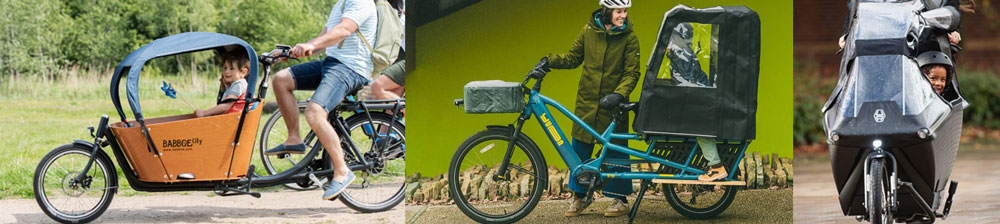
The rain canopy question
Rain is the feature that separates a bike you use daily from one that sits in the garage nine months a year.
What to check:
- Integrated or bolt-on? Integrated canopies (built into the seat or the bike’s safety rail system) fold up fast and stow compactly. Bolt-on aftermarket rain covers work but take longer and usually live in a pannier.
- Ventilation. A sealed rain cover in summer sun turns into a greenhouse inside of ten minutes. Mesh side panels or top vents matter.
- UV/sun protection. Many “rain canopies” are actually just waterproof. Check the UPF rating if sun exposure is real in your area.
- Doubles as a roll-cage? On good front-loaders, the rain canopy frame is also the structural roll protection in a tip-over. This is a hidden safety feature worth asking about.
What parents on forums keep repeating
Three patterns show up again and again in cargo bike community threads:
- “I wish I’d bought the bigger one first.” The top regret is under-buying. Second kid shows up, and the compact-fit bike has to go.
- “Test ride with the kids, not without.” A bike that felt great empty at the dealer rides completely differently with 35 kg of squirming children. Demand a real test ride with load.
- “The dealer network matters as much as the bike.” Cargo bikes need servicing. Hydraulic brakes, belt drives, mid-drive motors — you need a shop within 20 km that actually knows your brand. Buy from a brand with a dealer near you, or plan for self-service.
Budget vs. type — what’s worth it at each tier
Rough European pricing as of early 2026:
- €2,500–3,500: entry longtail with decent motor (Tern HSD, some Radwagon configurations). Fine for 1 kid, short routes, flat cities.
- €4,000–5,500: mid-tier longtail or entry front-loader (Tern GSD, Yuba Spicy Curry, base-spec Babboe). This is the sweet spot for most two-kid families.
- €6,000–8,500: premium front-loader (Urban Arrow Family, Riese & Müller Load, Larry vs Harry Bullitt with kid kit). Buy here if you’re genuinely high-mileage and need the hauling capacity.
- €8,500+: top-spec premium with dual battery, belt drive, premium motor. Justified only if this is truly replacing a car for daily use.
Recommended Reading:
- Best Electric Cargo Bikes 2026: Family Picks Tested
- Cargo Bike Types: How the Industry Actually Classifies Them
FAQ
What age can a child start riding in a cargo bike? Most rear-mounted child seats are rated from roughly 9 months, once the child can sit upright unassisted. For newborns, a front-box cargo bike with a car seat adapter (like the Maxi-Cosi mount on some Urban Arrow setups) is the usual route.
Is a longtail or front-loader safer? Neither is categorically safer — they fail differently. Front-loaders put kids in front of you in a protected box with visible safety. Longtails put kids behind, at hip height, in high-back seats. Crash data is limited; practical safety comes more from helmet use, speed discipline, and dedicated bike infrastructure than from bike type.
Can I use a normal child seat on a cargo bike? On longtails with a standard pannier rack and MIK HD mount, yes. On front-loaders, no — the seating is purpose-designed into the box.
Do I need a cargo bike licence or insurance? No licence in most of Europe. Insurance varies — in the Netherlands and Germany it’s common and recommended. Check your national cycling association for local rules.
The bigger picture
Cargo bikes are car replacements. That reframe matters. You’re not buying a premium bicycle — you’re buying the thing that takes your kids to school, you to the shops, and the dog to the park, without a car. Evaluated against a €15,000 small city car with €200/month in fuel, insurance and parking, even an €8,000 cargo bike pays back fast. The only bad cargo bike is the one that sits in the garage because it didn’t fit your life. Match the bike to your actual kid count, your body, your streets, and your weather — and it becomes the best vehicle you own.
Table of Contents
- Start with the kid count — present and projected
- Why longtail wins for 1–2 kids (especially if mom is the main rider)
- The front-loader case (when it actually makes sense)
- What to check on the child seat itself
- The rain canopy question
- What parents on forums keep repeating
- Budget vs. type — what’s worth it at each tier
- FAQ
- The bigger picture


