

You found a parking spot in 20 seconds this morning. You beat every car at the school drop-off. You hauled 60 lbs of Costco groceries up a hill without breaking a sweat. That’s life with the right electric cargo bike — and in 2026, more families are making the switch than ever before.
The question is no longer if an electric cargo bike can replace your second car. It’s which one does it best at your budget.
We’ve dug through hundreds of real-owner reviews, head-to-head test rides, and Reddit threads so you don’t have to. Below are the 7 best electric cargo bikes of 2026 for families, organized into three clear price tiers — with honest takes on who each one is (and isn’t) for.
Comparison Overview: Best Electric Cargo Bikes 2026
| Bike | Price | Capacity | Motor | Best For |
|---|---|---|---|---|
| Lectric XPedition 2.0 | $1,399–$1,999 | 450 lb | 750W hub, torque sensor | Best value overall |
| Velotric Packer 1 | $1,699–$1,999 | 440 lb | 750W hub, cadence sensor | Best-looking in budget tier |
| Aventon Abound LR | ~$1,999 | 440 lb | 750W hub, torque sensor | Best tech under $2K |
| Flyer Via Pro (Radio Flyer) | ~$2,299 | 400 lb | 750W hub, torque sensor | Best safety certs + out-of-box family ready |
| Rad Power RadWagon 5 | $2,199 | 375 lb | 750W hub, torque sensor | See note below |
| Specialized Globe Haul ST | $2,700 | 419 lb | 750W hub, torque sensor | Best fun-to-ride feel |
| Tern Quick Haul | ~$3,200 | 374 lb | Bosch mid-drive | Best entry into Bosch |
| Yuba Spicy Curry | ~$3,800–$4,500 | 440 lb | Bosch Cargo Line 85Nm | Best longtail for heavy daily use |
| Bunch Bike Original 4+ | ~$5,500 | 350 lb | 500W hub | Best trike for 4 kids, flat terrain |
| Tern GSD R14 / dual-battery | $5,799–$10,999+ | 463 lb | Bosch Cargo Line + ABS | GSD scaled to premium |
| Urban Arrow Family | $6,500–$8,500+ | 550 lb (total) | Bosch Cargo Line | Best for 2–4 kids (front-loader) |
| Cube Trike Hybrid | $7,000–$9,000+ | 2 toddlers + rider | Bosch Cargo Line | Best tilting cargo trike |
| Riese & Müller Load 75 | $8,900–$14,000+ | 440 lb | Bosch Cargo/Perf. | Full suspension, 3-kid front box |
Tier 1: Budget Picks ($1,399–$2,800)
For first-time buyers, smaller families, and anyone testing the waters
Who shops here:
You want to know if a cargo bike can actually replace some car trips before spending $5K+. Smart move. These bikes do 90% of daily family jobs without the premium price tag.
1. Lectric XPedition 2.0 — Best Overall Value, Full Stop

Price: $1,399 (single battery) / $1,699 (dual) / $1,999 (long-range dual)
Capacity: 450 lb total | 300 lb rear rack
Range: ~60 miles (single) / up to 140+ miles (dual)
If you follow cargo bike conversations on Reddit or YouTube, you already know this name. The XPedition 2.0 showed up and reset what “budget” means in this category.
Why real riders love it:
One tester in Boulder, Colorado, summed it up after climbing NCAR — a well-known training hill — fully loaded: two kids, a grocery haul, and a 12% grade. The bike didn’t bog down. It just climbed. That moment captures the XPedition 2.0’s core promise: hill-climbing power that used to cost three times as much.
The key upgrades in Version 2.0 over the original are exactly what riders asked for — a proper torque sensor (so the motor responds to your actual effort instead of just spinning pedals), a suspension fork for absorbing potholes, an extended rear rack that handles 300 lbs, and an 8-speed Shimano drivetrain replacing the old 7-speed. Price? Unchanged at $1,399.
What the numbers say:
- 750W motor peaking at 1,310W — faster up hills than most bikes at twice the price
- UL 2849 and UL 2271 certified (battery fire safety)
- Torque sensor + suspension fork at this price: essentially unheard of in 2024, now standard here
- Dual 35Ah battery option: up to 170-mile claimed range (real-world: ~140 miles with mixed loads)
The honest trade-offs: It’s 83 lbs. If you live on a third-floor walkup, that matters. The ride can feel stiff on rougher roads, and the kickstand takes a little getting used to. Some riders have reported support delays, so have realistic expectations.
Who this is for: Families on flat-to-moderate terrain who want maximum payload and range without the premium price. Anyone who hauls two kids to school daily and needs confidence the bike won’t stop on a hill.
Who should look elsewhere: Riders in very hilly cities who want the buttery feel of a Bosch mid-drive, or anyone who needs premium after-sales support on speed-dial.
→ [Check current price & specs — Lectric XPedition official page]
2. Aventon Abound LR — Best Budget Bike for Tech-Savvy Parents

Price: ~$1,999
Capacity: 440 lb total | 143 lb rear rack
Range: ~40–50 miles real-world
The Abound LR is what happens when a brand decides a cargo bike should also be a smart device. At under $2,000, it includes features reviewers said they’d only seen on $4,000–$8,000 bikes: GPS tracking, 4G connectivity, remote motor disable, a locking kickstand, integrated turn signals, and brake lights.
Why real riders love it:
Tester Joshua Hutchens at OutdoorGearLab called it “one of the most thoroughly equipped cargo bikes I’ve reviewed for the money.” The Aventon Control Unit (ACU) connects to an app that lets you geofence the bike, lock it remotely, and track its location in real time. One reviewer noticed a motion alert on their phone 30 seconds after walking away from a locked Abound — someone had bumped it on the street.
The 29-inch MIK-compatible rear rack fits two child seats comfortably. The torque sensor makes starts feel natural, the 50mm suspension fork handles urban roads well, and the integrated turn signals genuinely improve visibility for parents hauling kids in traffic.
What the numbers say:
- 708Wh LG cell battery (larger than most at this price)
- Turn signals + brake lights: standard, not an add-on
- Fits riders 4’11″–6’3″
- MIK compatibility: swap child seats, baskets, and panniers without tools
The honest trade-offs: Aventon has a mixed reputation for customer support. Multiple owner communities flag this consistently — it’s not rare, it’s a pattern. The stem can feel slightly loose when very heavily loaded, and taller riders (6’+) may not get full leg extension. The hub motor won’t deliver the silk-smooth feel of Bosch’s mid-drive systems.
Who this is for: Urban parents who want connected security features and integrated lighting that most competitors charge extra for. Great for families doing school runs and grocery trips in areas where bike theft is a real concern.
Who should look elsewhere: Anyone who prioritizes long-term support experience, or who needs maximum hill performance on sustained climbs.
→[Check current price & specs — Aventon official Abound page]
3. Rad Power RadWagon 5 — A Note Before You Buy

Price: ~$2,199
Capacity: 375 lb total | 120 lb rear rack
Range: ~45–60 miles
Let’s be straight with you: Rad Power Bikes filed for Chapter 11 bankruptcy protection in early 2025. The RadWagon 5 itself remains a well-reviewed bike — improved hydraulic disc brakes, a new UL-certified SafeShield battery, torque sensor, Class 1/2/3 switchable, lower step-over height — and the 5th generation genuinely fixed a lot of what held the 4th back. But before you buy, you need to weigh the brand’s uncertain service and parts future against that lower price tag.
If you’re comfortable with that uncertainty (and can find a local mechanic who services e-bikes), the RadWagon 5 is a capable, stable, family-friendly hauler. It “rides like a big American car from the 70s” — calm, planted, and confidence-inspiring even fully loaded. The low center of gravity makes it one of the most stable bikes to ride with two kids on the back.
The honest take: We’re not removing it from our list because it’s a genuinely good product — but we’d recommend confirming dealer support in your area before purchasing.
→ [Check current price & specs — Rad Power RadWagon 5 official page]
4. Specialized Globe Haul ST — The One That Makes Riding Actually Fun

Price: $2,700
Capacity: 419 lb total
Range: ~35–50 miles real-world (60 miles claimed)
Every cargo bike reviewer eventually writes a version of the same sentence about the Globe Haul ST: “I didn’t expect to like it this much.”
One Velo reviewer spent six months testing $10,000+ road bikes and still called the Globe Haul ST the most impactful bike of the year. The reason is feel. Specialized tuned the 750W hub motor with one of the most responsive torque sensors in the class — it accelerates quickly and naturally, handles hills with confidence, and the nimble 20-inch wheelbase means it doesn’t lumber through parking lots like a bus.
The 1,500-lumen integrated headlight draws from the massive 772Wh battery, the 4-piston hydraulic disc brakes with 203mm rotors are among the best in the category, and the lifetime frame warranty plus Specialized’s dealer network give you an after-sales experience most direct-to-consumer brands can’t match.
What the numbers say:
- Class 3: 28 mph assist
- Fits 4’5″–6’4″ riders — one of the widest ranges in the category
- 772Wh battery: largest in this price tier
- 9-speed microSHIFT drivetrain
The honest trade-offs: The rear cargo platform is shorter than a full longtail — it’s designed for one child passenger or moderate cargo, not two kids simultaneously. Accessories (panniers, child seat, front rack) are mostly proprietary and add $400–$800 to the real-world cost. Range dips fast on steep terrain in higher assist modes.
Who this is for: Single-kid families and active riders who want a cargo bike that rides like a sporty commuter when unloaded. Anyone who values dealer support and lifetime warranty. Commuters who also want to carry one child.
Who should look elsewhere: Families with two kids who need to ride simultaneously, or buyers who want maximum cargo rack space for long panniers.
→ [Check current price & specs — Specialized Globe Haul ST official page]
5. Velotric Packer 1 — The Underrated One That Looks Way More Expensive Than It Is

Price: ~$1,699–$1,999
Capacity: 440 lb total | 176 lb rear rack
Range: ~40–52 miles
Most people haven’t heard of Velotric. That’s exactly why this bike is on this list.
The Packer 1 has been flying under the radar since its launch, but reviewers who have tested it keep saying the same thing: “the fit and finish feels like they’ve been doing cargo bikes for years.” For a brand’s first cargo entry, that’s a remarkable verdict. The build quality — clean internal cable routing, flawless paint, properly integrated battery — matches bikes that cost $500 more. At 75 lbs it’s one of the lightest longtails in the category.
The detail that wins parents over:
The Packer uses a “mullet” wheel setup — a 26″ front wheel for stability and speed, a 20″ rear wheel to keep the cargo rack low and the center of gravity planted. In practice, this means the loaded bike handles more predictably than most longtails when cornering with kids on the back. One reviewer hauled three passengers simultaneously (two 11-year-olds plus a 5-year-old) and described the bike as “perfectly balanced even with that kind of load.” Apple Find My is built directly into the frame — not a separate tracker you hide — and the 4-piston hydraulic disc brakes with 180mm rotors give confidence that most bikes at this price don’t.
The Child Safety Balustrade accessory ($49) encloses the rear rack area for smaller kids who need containment — it’s one of the most thoughtful child-safety add-ons in the category at this price.
What the numbers say:
- 750W motor, 1,200W peak — strong hill performance
- 176 lb rear rack: highest capacity in Tier 1
- 80mm hydraulic suspension fork: rare at this price
- Apple Find My integrated (no app required, works even if Velotric ever shuts down)
- UL 2271 + UL 2849 certified
- 8-speed Shimano, 75 lb total weight
The honest trade-offs: Uses a cadence sensor rather than a torque sensor — the motor response isn’t as smooth as the Lectric XPedition 2.0 or Aventon Abound. Under very heavy loads (near 400+ lb total), some testers noted the frame feels slightly flexible. Pannier compatibility is limited — the bamboo deck doesn’t accept standard Ortlieb quick-release clips without adapters.
Who this is for: Parents who want maximum rear rack capacity and the lightest possible bike at this price. Families who like the idea of built-in theft tracking without paying for a subscription. Anyone who values aesthetics — this is genuinely the best-looking bike in Tier 1.
Who should look elsewhere: Riders who need silky torque-sensor feel on hills, or who haul full panniers daily with standard bags.
→ [Check current price & specs — Velotric Packer 1 official page]
6. Flyer Via Pro (by Radio Flyer) — The 100-Year-Old Brand That Quietly Built One of the Safest Cargo Bikes in America

Price: ~$2,299
Capacity: 400 lb total | 150 lb rear rack
Range: ~40–65 miles real-world
Yes, that Radio Flyer. The same brand that made the little red wagon in your childhood garage just won Fast Company’s 2025 Innovation by Design Award for the Via Pro — and the reason has nothing to do with nostalgia.
The Flyer Via Pro is one of a tiny handful of US-market cargo bikes certified to both UL 2849 and DIN 79010. That’s the German cargo-loading standard that tests the entire bike system — fork, brakes, frame — under conditions simulating real family loads. Most brands only certify the battery. Radio Flyer went further because, as CEO Robert Pasin put it: “This is how we ensure safety for your kids — and ours.”
What makes it stand out in a crowded Tier 1:
It’s the rare cargo bike that arrives genuinely ready for kids — no additional purchases required on day one. The base model comes with padded rear seat, carrier hoop handrail, footboards, and wheel guards already installed. Every other bike in this tier ships barebones and asks you to spend $150–$300 more to make it usable with children.
The 750W motor with torque sensor delivers one of the smoothest and most range-efficient rides in this tier — one tester covered 65.6 miles at PAS 1 with a 150 lb rider. The 24″ front / 20″ rear mixed-wheel setup creates a lower-than-usual center of gravity, and the suspension fork absorbs urban potholes well. Integrated turn signals and brake lights are among the brightest in any class of cargo bike. Three frame sizes fit riders from 4’10” to 6’10” — the widest range we’ve seen anywhere.
What the numbers say:
- 750W motor + torque sensor: one of the smoothest in Tier 1
- 687Wh battery: above average for the price
- DIN 79010 + UL 2849 + UL 2271: rare triple certification
- B Corporation certified: the only e-bike brand with that status
- Arrives with child passenger setup included — no extra cost
- 4’10″–6’10” rider height range: widest in the category
The honest trade-offs: 400 lb total capacity is slightly lower than some competitors (Lectric at 450 lb, Velotric at 440 lb). The rear taillight placement under the rack means it can be partially blocked by certain accessories. Range drops faster than claimed on steep terrain at higher assist levels.
Who this is for: First-time cargo bike parents who don’t want to immediately spend $300 more on accessories before the first school run. Families who care about safety certifications deeply. Anyone in a city with good bike infrastructure who wants to genuinely replace short car trips.
Who should look elsewhere: Heavy haulers who need maximum payload, or buyers in hilly cities who need dual-battery range options.
→ [Check current price & specs — Flyer Via Pro official page]
Tier 2: Mid-Range ($3,000–$5,999)
For growing families planning 5+ years of daily use
The Reddit consensus in this tier: “Worth the extra money for the Bosch motor and way better brakes and suspension.” The key upgrade you’re paying for is a Bosch mid-drive motor — quieter, more efficient on hills, and significantly smoother than hub-drive options. These bikes are built to still be running in a decade.
1. Tern Quick Haul — Your Entry Point to Bosch

Price: Quick Haul D8:~$2,999 / Quick Haul P9:~$3,299 / Quick Haul Long D9:~$3,999(Bosch Cargo Line)
For: Riders who want Bosch reliability without the full GSD footprint
The Quick Haul is Tern’s most affordable model, and it punches well above its price. It brings a Bosch mid-drive motor, hydraulic disc brakes, the Tern vertical parking feature (stands the bike on its rear for apartment storage), and access to Tern’s wide accessory ecosystem — all at a price that doesn’t require the “buy once, cry once” conversation with your partner.
It’s lighter and more nimble than the GSD, making it ideal if you mostly haul one child plus groceries on mixed terrain.
→ [Check current price & specs — Tern Quick Haul official page]
2. Specialized Globe Haul LT — The ST’s Bigger Sibling. Completely Different Animal.

Price: $3,500–$3,800
Capacity: 441 lb total | 176 lb rear rack
Range: ~40–55 miles real-world(60 miles claimed)
If the Globe Haul ST in Tier 1 is the Swiss Army knife, the LT is the pickup truck. They share a motor and a badge, but almost nothing else. The LT’s 31-inch rear rack is literally twice the length of the ST’s — six full-size panniers, two child seats, or three kids simultaneously, with room to spare. It earned GearJunkie’s “Best Overall E-Cargo Bike” in 2024, and one tester called it “a very talented bike” after 2,200km of daily daycare runs in Canada.
Why families choose it over the ST:
The ST is one child plus groceries. The LT is school-run-for-two plus a Costco haul. One Seattle parent logged 850 miles over 12 weeks — loaded both kids in seats, four panniers of groceries, a 40-pound bag of dog food, and soccer gear — and the Haul LT “just went. No struggling, no drama.” That’s the sentence that tells you which tier this bike belongs in.
The 700W hub motor with torque sensor is tuned more aggressively than most cargo bikes — Class 3, 28 mph assist — and the 772Wh battery is the largest in this tier. The MIK-compatible deck accepts up to six rigid Coolcave panniers simultaneously. The 4-piston Tektro hydraulic disc brakes with 203mm rotors are among the best-reviewed in the cargo category. And behind it all sits Specialized’s lifetime frame warranty plus a dealer network that can actually service the bike when needed.
What the numbers say:
- 700W hub motor, torque sensor, 28 mph Class 3
- 772Wh battery (largest in this price range)
- 441 lb total | 176 lb rack — fits 3 child seats
- Fits 4’5″–6’4″ riders on one frame
- Lifetime frame warranty + dealer network
- MIK-compatible rack: 6-pannier capacity
The honest trade-offs: At 88–90 lbs unloaded, this is a heavy bike. Some early production units had an electronic “power off” bug that has since been patched, but it’s worth confirming dealer warranty coverage before buying. The proprietary accessories are excellent but expensive — expect to add $600–$1,000 for a functional two-kid setup. No chain guard is an oversight on a $3,500 family hauler. And unlike the ST, the LT’s length (77 inches full) means you need real storage space.
Who this is for: Families with two kids who need to ride simultaneously, or one kid plus serious grocery capacity. Riders who liked the ST but needed more rack. Anyone who values Specialized’s dealer support and lifetime warranty, and who wants the best longtail at the $3,500 price point.
Who should look elsewhere: Apartment dwellers without dedicated bike storage. Parents who need the compact footprint of a short-tail bike. Anyone who prioritizes light weight.
→ [Check current price & specs — Specialized Globe Haul LT official page]
3. Yuba Spicy Curry — The Longtail That Real Cargo Riders Keep Coming Back To

Price: ~$3,800–$4,500 (depending on build)
Capacity: 440 lb total | 300 lb rear rack
Range: ~50–70 miles
The Yuba Spicy Curry is one of those bikes that doesn’t get nearly enough attention in “best of” lists — and then you meet someone who owns one and they’ve logged 2,000 miles on it and won’t stop talking about it.
The Spicy Curry has been refined across four generations, and the V4 (2024/2025) is the best yet. It uses the same Bosch Cargo Line motor and Smart System found on the Tern GSD — 85Nm of torque, GPS tracking, eBike alarm — but the frame philosophy is different. Yuba’s “Stay Steady Technology” geometry was designed specifically for carrying three children, or one child plus an adult passenger, simultaneously. The 20″ rear wheel keeps the cargo platform exceptionally low — lower than most Bosch longtails — and after 4 generations, every accessory fits cleanly and intuitively.
Why long-term owners stay loyal:
“I now have almost 2,000 miles on the Yuba Spicy Curry in the four months since buying it. I haven’t regretted the purchase for a minute.” That’s a real owner with 2,000 miles in four months — the kind of person who uses it as a car, not a weekend toy. Another summed it up: “This bike was a game changer for our family. It could replace a second car for 8 months of the year.”
One owner in Mexico rode it on cobblestone jungle roads. Another swapped it between hauling kids to school and carrying kayaks on the weekend. The accessory range is genuinely the broadest in the longtail category — surfboard rack, ski carrier, bamboo cargo deck, Monkey Bars kids’ handrail system — and every piece is purpose-built, not an afterthought.
At only 60 lbs, it’s significantly lighter than the Tern GSD (which weighs roughly 75+ lbs fully kitted). That matters when you’re hauling it up apartment stairs or loading it into an SUV for a weekend trip.
What the numbers say:
- Bosch Cargo Line: 85Nm, same motor as the Tern GSD
- 60 lb bike weight: meaningfully lighter than GSD
- 300 lb rear rack rating: highest longtail rack in this tier
- Broadest accessory ecosystem of any longtail (including surfboard + ski rack)
- Bosch Smart System: GPS, alarm, app-based tuning, OTA updates
- 20″ rear / 26″ front wheels: lower center of gravity than 20/20 bikes
The honest trade-offs: The Yuba is sold through dealers (good for support, less convenient than direct-to-consumer). Unlike the Tern GSD, it can’t stand vertically for compact storage — you’ll need normal bike-length floor space. No ABS braking option (GSD has it). Some accessories require a bit of muscle to install due to mounting tolerances.
Who this is for: Riders who do serious daily mileage and want a longtail that’s genuinely lighter than a GSD, with a deeper accessory catalog for adventures beyond the school run. The all-terrain V4 version suits families in areas with gravel paths, loose surfaces, or uneven roads.
Who should look elsewhere: Anyone with tight storage who needs the Tern’s vertical parking trick, or buyers who want Bosch ABS braking as a hard requirement.
→ [Check current price & specs — Yuba Spicy Curry official page]
Tier 3: Premium ($6,000–$10,000+)
For 2–3 kids, maximum comfort, and zero compromises
Why go premium: You’re not just buying a bike. You’re buying a vehicle that will log 20+ miles per day, carry 3 children in all weather, and outlast most things in your garage by a decade.
1. Urban Arrow Family — The Ultimate Front-Loader for Multi-Kid Families

Price: $6,500–$8,500+ (varies by spec)
Capacity: 550 lb total | 275 lb front box
Range: ~25–35 miles real-world (single battery); dual battery extends this significantly
If the GSD is a truck, the Urban Arrow Family is a minivan — and that’s meant as the highest compliment possible.
The front-loading box format means you can watch your kids while you ride. Not glance back nervously. Watch them. The EPP box (same material as the inside of a bike helmet — incredibly light and strong) comfortably fits three children, with Maxi-Cosi newborn adapter available and belt-restrained seating for up to 4 riders. Kids love the box — one reviewer’s kids “fight over who gets to sit in the front.”
The Bosch Cargo Line motor (85Nm) powers through intersections and hills with a stillness that feels impossible for something carrying this much weight. The Gates Carbon belt drive and Enviolo stepless hub require almost zero maintenance — no chain lube, no derailleur adjustments, no cassette replacements. Magura CMe hydraulic disc brakes (optional ABS) are among the most confidence-inspiring in the category.
Why real riders love it:
A Cycling Weekly reviewer replaced their family’s second car entirely within two months: “It made us happier, saved money on fuel and genuinely improved my mental health. In just a couple of months, we’ve fully adopted the Tern GSD cargo life as a car replacement.” (Note: similar sentiment applies directly to Urban Arrow owners.)
One parent at Cycling UK was “blown away by how easy it was to ride” despite the bike being 262cm long, 70cm wide, and 51kg — with a five-year-old in the front box, on busy London streets.
What the numbers say:
- Bosch Cargo Line: 85Nm, seamless start-stop power
- Gates Carbon belt drive: ~3× the lifespan of a chain, near-silent
- Enviolo hub: shift gears at a standstill, infinite adjustability
- Optional rain cover: standard on many configurations
- 5-year frame/fork warranty
The honest trade-offs: The single 482Wh battery gives a real-world range of 20–35 miles depending on load and terrain — many families with longer commutes opt for the dual-battery setup. The bike is 9 feet long; storage and parking require planning. Maneuvering on foot (parking, tight spaces) is awkward. No suspension fork — the tires handle most bumps, but you’ll feel sharp potholes.
Who this is for: Families with two, three, or even four young children. Parents who want their kids in view at all times. Anyone commuting daily in a city where a front-loader is culturally normalized (common in the Netherlands, Germany, Denmark, and increasingly popular in the US and UK).
Who should look elsewhere: Anyone with limited storage space (this bike needs real dedicated space). Single-child families who don’t need the box — a longtail like the Tern GSD will be easier to live with.
→ [Check current price & specs — Urban Arrow Family official page]
2. Tern GSD (High-Spec / Dual-Battery Builds) — The Longtail That Scales Into Premium

Price: $5,799–$10,999+ (R14 and dual-battery configurations)
The Tern GSD Gen 3 starts at $5,799(P10 Gen 3), but it’s worth noting that Tern builds it across multiple spec levels — and the high-end configurations cross cleanly into premium territory. Add a second 400Wh Bosch battery, step up to the R14 build (USB-C port, Bosch Smart System with GPS and eBike alarm, Kiox 300 display), and you’ve got a machine that hauls 463 lbs, stores vertically in a hallway, tows a trailer, and runs an entire week of daily school runs on a single overnight charge.
In real-world use, owners on the dual-battery R14 have reported exceeding the 150-mile claimed range — running in Turbo assist the majority of the time and still not needing to charge more than once a week. That’s the kind of practical range that makes cargo bike ownership genuinely effortless rather than battery-math-dependent.
GSD high-spec vs. Urban Arrow Family — how to decide:
The GSD is the right call if you want a longtail that handles and stores like a normal bike, and your kids ride behind you. The Urban Arrow wins if you have 2–3 young children you want visible and enclosed in front of you at all times. Both are serious 10-year bikes. The form factor is what differs, not the quality.
→ [Check current price & specs — Tern GSD official page]
3. Riese & Müller Load 75 — For Buyers Who Want Zero Compromises, Period
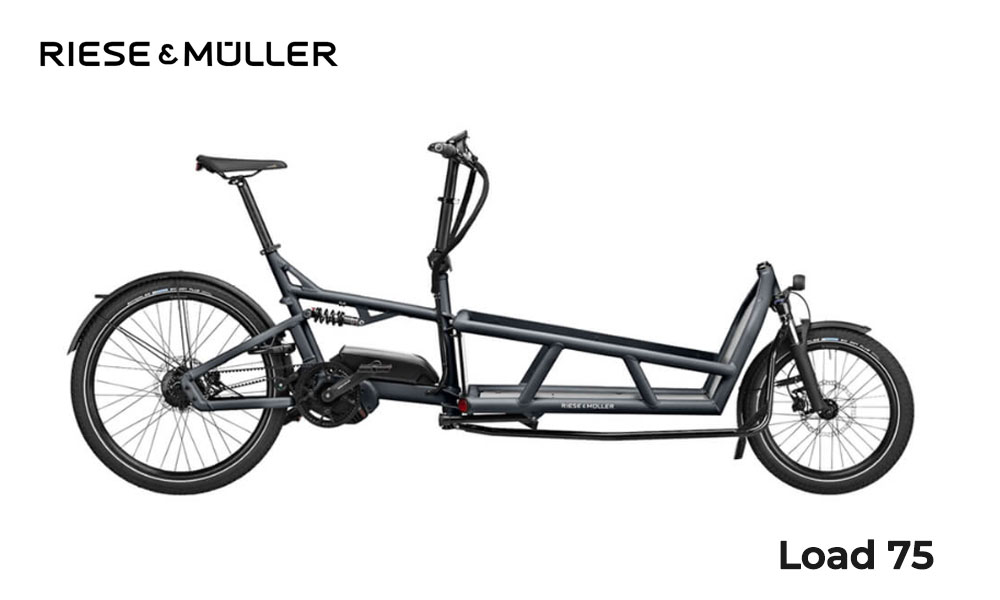
Price: $8,900–$11,000+ (depending on spec, battery, and box configuration)
Capacity: 440 lb total | Configurable front box
Range: ~35–40 miles (single 725Wh) / 60–70 miles (dual battery, 1,450Wh)
The Riese & Müller Load 75 is the only cargo bike on this list that reviewers consistently describe with one phrase: “it feels like nothing else.” That’s because of one feature no other front-loading cargo bike in production currently offers at this weight capacity — full dual suspension.
Every other front-loader (Urban Arrow, Babboe, Butchers & Bicycles) uses rigid frames. The Load 75 has full air suspension front and rear. When you’re carrying 200kg over cobblestones, speed bumps, or rough city roads, the difference isn’t subtle — one Cycling Electric reviewer described it as “gliding” where comparable bikes jar and shudder. For the passenger in the box, the impact is even more significant.
Why real riders love it:
One reviewer in the Netherlands replaced their car entirely within weeks: “The car now doesn’t leave its spot unless I have to travel further than 45km from home.” A London family at Fully Charged, who’s used a Load daily for five-plus years and close to 10,000 miles, still calls it the right decision — and notes the bike holds its resale value exceptionally well, often fetching several thousand pounds used because the platform is so well-regarded.
The engineering depth is serious. R&M builds to order (expect 1–3 months in North America). You configure the bike to your spec: Bosch Cargo Line or Performance Line Speed motors (both 85Nm), Shimano Deore XT chain drive or Gates Carbon belt drive with Enviolo or Rohloff hub gearing, 725Wh or dual 1,450Wh battery, optional ABS 2.0 braking, optional child seats and weatherproof cover. The front box fits up to three child seats with harnesses, a Maxi-Cosi newborn adapter, or a hard cover for cargo-only configuration.
What the numbers say:
- Full dual suspension: unique in this category at this capacity
- Bosch Cargo Line: 85Nm, 400% max assist
- Gates belt + Enviolo/Rohloff: lowest-maintenance drivetrain available
- Bosch ABS 2.0: anti-lock braking at full load
- Front box cargo space: roughly equivalent to a Toyota Corolla sedan trunk
- Built-to-order: every R&M is configured at the factory to your spec
The honest trade-offs: It’s expensive — the entry-level spec starts at $8,900 before box, accessories, or second battery. The 104-inch length makes urban storage genuinely challenging. The tarpaulin cargo cover gets mixed reviews (fiddly to attach and remove). The 154 lb front box capacity is actually below some front-loaders in this class (Urban Arrow goes higher). And in North America, the 1–3 month build time requires planning ahead.
Who this is for: Families for whom the Urban Arrow is the right concept but who want the comfort of full suspension — particularly those with longer commutes on rough roads, or carrying a baby who will feel every bump. Also for buyers in the EU and UK where R&M’s dealer network is most robust and the HS (45 km/h) version unlocks fast commuter speeds.
Who should look elsewhere: Urban apartment dwellers (the length is genuinely problematic). Anyone with a tighter budget — the GSD or Urban Arrow give you 85–90% of this bike’s capability for half the price. North American buyers who can’t wait 1–3 months.
→ [Check current price & specs — Riese & Müller Load official page]
Bonus Tier: Electric Cargo Trikes — A Completely Different Animal
Every bike above has two wheels. This section covers three — and if you have younger kids, a disability, or simply hate worrying about balance at low speeds, a trike completely changes what’s possible.
Cargo trikes are not slower or inferior versions of cargo bikes. They’re a different vehicle category with genuine advantages: they stand upright on their own (no kickstand needed), can be safely loaded and unloaded while stationary without holding the bike, and can carry wider loads that would destabilize a two-wheeler. The trade-off is that they’re wider, can’t lean into turns, and require more storage space. Once you’ve test-ridden one, the handling quirks become second nature — most owners report a 20–30 minute adjustment period.
1. Bunch Bike Original 4+ — The One That Fits 4 Kids in the Front Box
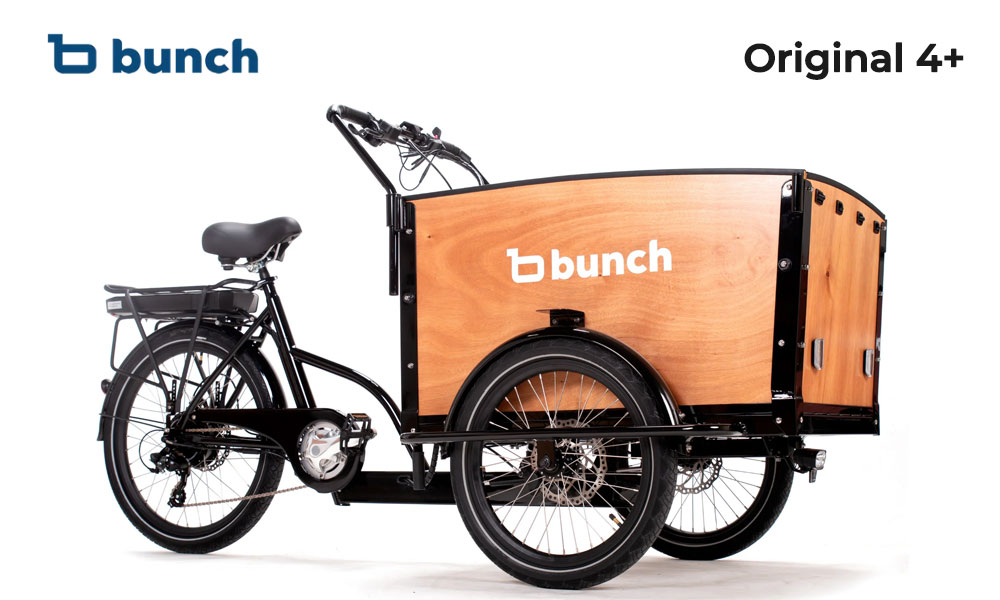
Price: ~$5,500–$5,999
Capacity: 350 lb total (rider + up to 4 children)
Range: ~30–35 miles
Ships: Fully assembled, to your door, within 2 weeks in the US
The Bunch Bike Original 4+ is a front-load electric cargo trike built in Texas, and its product category is essentially: “what do you ride when you have three kids, don’t want to drive, and want them all facing you and smiling?”
The front cargo box holds 4 children with 3-point seatbelts. The benches are removable and double as locking storage. An optional rain canopy (highly recommended for year-round use) encloses the front compartment completely — one Idaho parent described riding in snowstorms with a toddler “warm and cozy” inside. Because it’s a trike, it never tips when you’re loading, at a stoplight, or parked on a slope. That feature alone is transformative for parents who’ve wrestled with loaded two-wheelers at red lights.
Why families who buy it become evangelists:
The customer feedback is unusually emotional for a cargo bike review. “Life changing.” “It’s changed our mornings.” “I haven’t regretted it for a minute.” One parent of three young children — who doesn’t drive — replaced a wagon with the Bunch Bike and now uses it for school commutes, grocery runs, doctor appointments, and playgrounds. A disabled parent noted that the trike’s stability made riding possible again. Bunch explicitly offers free adaptive equipment and discounts to special-needs families.
The customer service reputation is notably exceptional — owners consistently single it out. “My gosh, the customer service. The company seems honest, earnest, and committed to their cargo bike community. A+ experience there.” That matters when you’re spending $5,500 and learning a new type of vehicle.
What the numbers say:
- 4 seatbelted front seats (or 2 adults + cargo)
- Ships fully assembled — ride same day
- 500W rear hub motor, 652Wh Samsung battery
- Optional rain canopy + toddler/infant seat available
- UL 2271 + UL 2849 certified (4+ model)
- Built and tested in-house in Texas
- 30-day trial period on new US bikes
The honest trade-offs: This is not a fast bike — top speed is realistically 15–18 mph, and steep hills require realistic expectations from a 500W motor. The three-wheel design requires turning at lower speeds and reading the road further ahead; it’s a genuine learning curve (Bunch provides a tutorial video that’s genuinely helpful). At 152 lbs unloaded, it’s not moving upstairs. And it needs real width — both for riding (it’s wider than most bike lanes) and storage. Not ideal for tight urban apartments or neighborhoods with very steep grades.
Who this is for: Families with 2–4 young children (especially ages 1–8) who want all kids visible, enclosed, and seatbelted in the front. Non-cyclists or less confident riders who want stability over maneuverability. Special needs families. Anyone willing to trade speed for safety and cargo capacity.
Who should look elsewhere: Avid cyclists who want to maintain speed and pace. Riders in hilly cities. Anyone in a tight apartment where a 5-foot-wide, 6-foot-long vehicle won’t fit.
→ [Check current price & specs — Bunch Bike official page]
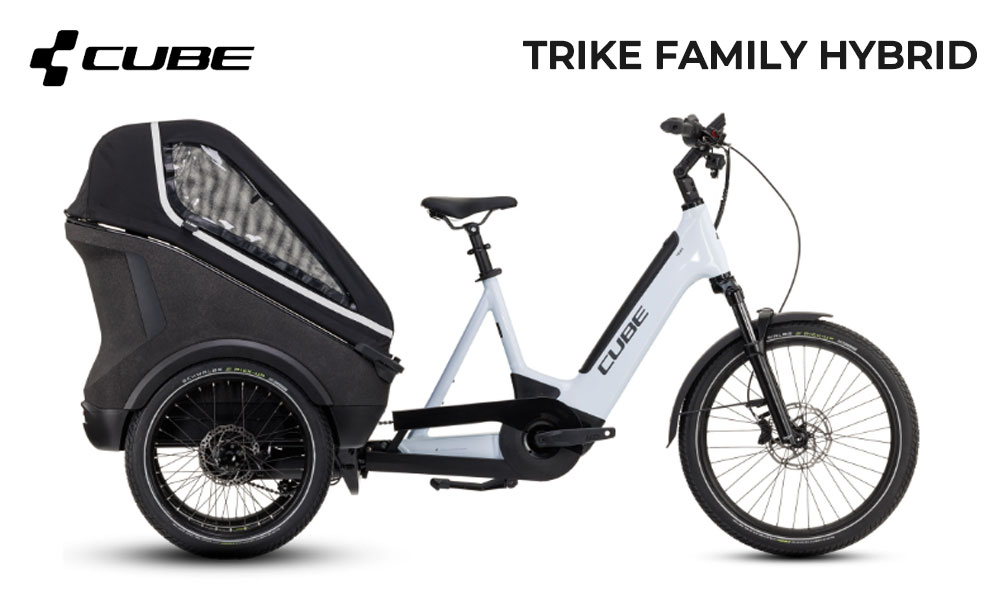
2. Cube Trike Hybrid — The Engineer’s Answer to What a Cargo Trike Should Feel Like
Price: ~$7,000–$9,000 (varies by market)
Capacity: Rider + 2 toddlers (removable rear cabin)
Motor: Bosch Cargo Line (85Nm) | Battery: 625Wh
Available: Primarily EU/UK, expanding to North America
If the Bunch Bike is built by parents, the Cube Trike Hybrid was co-developed with BMW engineers — and the goal was to make a cargo trike that rides like a bike.
The core problem with traditional cargo trikes is that they can’t lean into corners. That creates an awkward, “shopping trolley” sensation and makes riders artificially slow. Cube solved this with a tilting chassis: the bike leans naturally at speed while all three wheels stay planted at low speeds. The result, according to Cycling Electric, is that “corners feel natural” in a way that non-tilting trikes simply can’t replicate. At higher speeds you get bike-like handling; at low speeds and when stopped you get trike-like stability. It’s the best of both formats.
The rear cabin seats two toddlers with seatbelts, with excellent ventilation and weather protection. It’s fully removable for cargo-only configuration. A Bosch Cargo Line motor and Gates carbon belt drive handle the mechanical side, with Magura hydraulic brakes for stopping power. A parking lock keeps the trike stationary when loading — essential on any incline.
What the numbers say:
- Tilting chassis: handles like a bike, parks like a trike
- Bosch Cargo Line: 85Nm torque, same as GSD and Yuba
- Gates Carbon belt drive: near-zero maintenance
- 625Wh Bosch PowerTube battery
- Removable rear cabin: converts to cargo-only in minutes
- Co-developed with BMW engineers
The honest trade-offs: Availability is currently limited — primarily EU and UK markets, with North American distribution still expanding. The tilting mechanism is mechanically sophisticated and requires skilled service. At $7,000+, it sits significantly above the Bunch Bike for a different type of passenger experience (rear-facing, enclosed cabin vs. front-box open seating). Storage width remains a factor — wider than any longtail.
Who this is for: EU and UK families who want the stability of a trike with the ride feel of a bike. Parents of 1–2 toddlers who prioritize enclosed, weatherproof rear seating. Riders who’ve been put off by the handling of traditional non-tilting trikes.
Who should look elsewhere: North American buyers without confirmed local dealer access. Families who need 3–4 seats simultaneously (the Bunch Bike is the answer there).
→ [Check current price & specs — Cube Trike Hybrid official page]
Which Tier Is Right for You? (A 60-Second Decision)
Start here if you’re unsure:
- “I want to try cargo biking without a huge commitment” → Lectric XPedition 2.0 ($1,399). You’ll either love it enough to upgrade, or you’ll have spent $1,400 to know that.
- “I do school runs daily with one kid + groceries” → Aventon Abound LR ($1,999) for tech features, or Specialized Globe Haul ST ($2,700) for best ride feel.
- “I need this to last 7–10 years, daily use, two kids” → Tern GSD Gen 3. It’s the benchmark for a reason.
- “I have two or three young kids and want to see them while I ride” → Urban Arrow Family. This is what it was built for.
- “I want the Urban Arrow concept but my commute is rough and I need full suspension” → Riese & Müller Load 75. More money, genuinely different ride quality.
Pro Tips From Real Riders
On accessories: Budget an extra $200–$500 beyond the bike price for the accessories that make cargo bikes work for kids — child seats, panniers, and wheel covers. These aren’t optional extras; they’re what makes the magic happen.
On test rides: Most local bike shops in major US, Canadian, UK, and European cities now stock at least one or two of the bikes on this list. Test-riding before buying is worth the trip — cargo bikes have very different ride feels, and what works for one parent doesn’t always work for another.
On hills: If you live in San Francisco, Seattle, or any hilly city, prioritize the dual-battery option or a mid-drive motor. Hub motors handle hills fine, but they drain battery faster on sustained climbs with full loads.
On safety certification: For any bike carrying children, look for UL 2849 (full electrical system) certification and ideally DIN 79010 (whole-bike cargo loading test). Some brands only certify the battery or frame separately — that’s not the same level of testing.
Last updated: March 2026. Prices and availability may vary. This page contains affiliate links to manufacturer websites. When affiliate accounts are approved, commission links will replace direct links — you always pay the same price.
Table of Contents
- Quick Go-To
- Comparison Overview: Best Electric Cargo Bikes 2026
- Tier 1: Budget Picks ($1,399–$2,800)
- 1. Lectric XPedition 2.0 — Best Overall Value, Full Stop
- 2. Aventon Abound LR — Best Budget Bike for Tech-Savvy Parents
- 3. Rad Power RadWagon 5 — A Note Before You Buy
- 4. Specialized Globe Haul ST — The One That Makes Riding Actually Fun
- 5. Velotric Packer 1 — The Underrated One That Looks Way More Expensive Than It Is
- 6. Flyer Via Pro (by Radio Flyer) — The 100-Year-Old Brand That Quietly Built One of the Safest Cargo Bikes in America
- Tier 2: Mid-Range ($3,000–$5,999)
- Tier 3: Premium ($6,000–$10,000+)
- Bonus Tier: Electric Cargo Trikes — A Completely Different Animal
- Which Tier Is Right for You? (A 60-Second Decision)


