

Most cargo bike buyers think an audit is about checking documents and walking through a factory.
In reality, that only tells you what the factory wants you to see.
A proper audit answers a much harder question:
what will happen when things go wrong during production?
If you’ve already read How to Negotiate with Chinese E-Bike Suppliers Without Losing on Price, Quality, or Delivery, you know that delivery, pricing, and communication are never as stable as they appear at the quotation stage. A factory audit is where you verify whether the supplier has the internal structure to handle that instability.
A Factory Audit Is Not a Visit — It Is a System Check
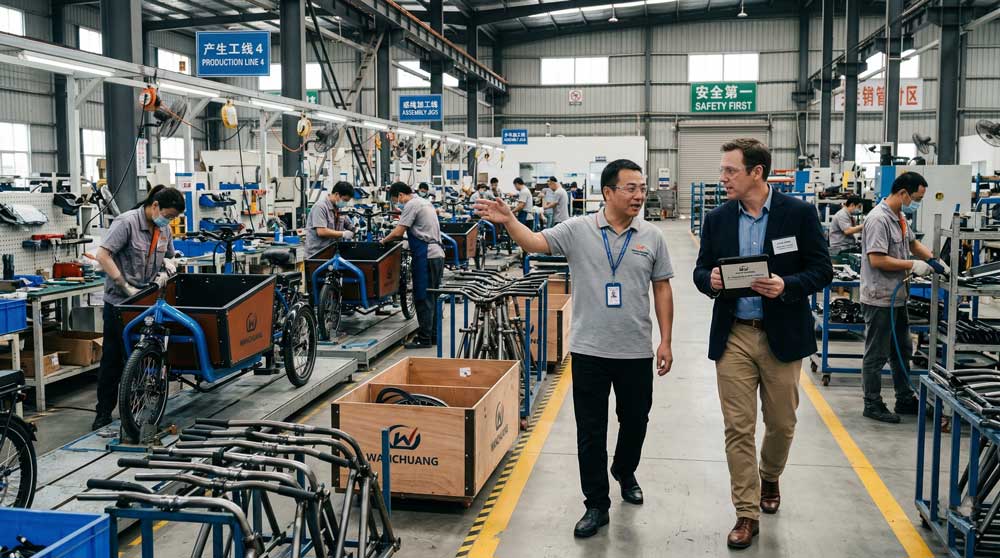
The biggest mistake is treating an audit as a visual inspection. A clean workshop, organized assembly lines, and even modern equipment can be misleading if they are not supported by a functioning system behind them. What actually matters is whether the factory operates with repeatable processes, documented controls, and clear accountability.
This is where the TQA (Technical Quality Audit) framework becomes useful. A serious factory should be able to provide structured documentation covering its operations, not just general introductions. Documents such as business licenses, organization charts, and ISO certifications are only the starting point. What matters more is whether internal processes like quality control, supplier management, and production planning are formally defined and consistently executed .
Free Download: Cargo Bike Factory Audit Sheet (Excel/Editable)
1. The First Step: Verify Identity Before Capability
Before evaluating how well a factory produces cargo bikes, you need to confirm what it actually is. Many suppliers present themselves as manufacturers, but operate as assemblers coordinating multiple upstream partners. This distinction is critical because it determines how much control they have over delivery timelines and quality consistency.
The verification process is not complicated, but it requires attention to detail. Business licenses should match the production location, and the factory address should align with where actual manufacturing takes place. If frame production happens at a different site, you are no longer auditing one factory but a distributed supply chain. For cargo bikes, where frame manufacturing defines both quality and lead time, this difference has direct operational impact.
Understanding this also helps you interpret what you see later in the audit. A factory that controls its own frame production behaves very differently from one that depends on external suppliers, even if their final products look similar. This is especially relevant when comparing different Cargo Bike Types, since structural complexity varies significantly across designs.
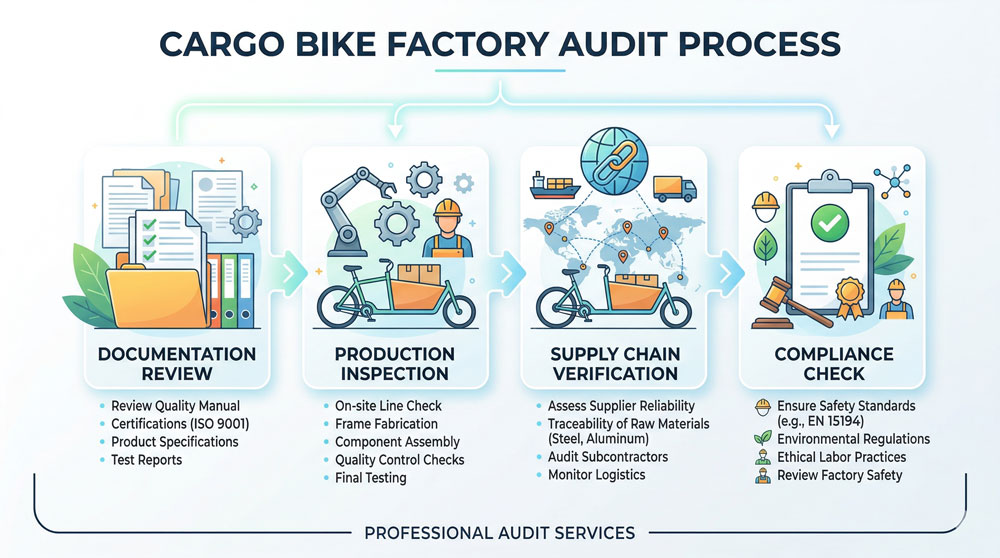
2. Documentation Is Not Formality — It Reveals How the Factory Thinks
Most buyers request documents, but few actually read them as operational signals. A complete audit file typically includes quality manuals, inspection standards, defect classification systems, and records of incoming, in-process, and final inspections . These are not just compliance requirements; they show whether the factory runs on structured processes or improvisation.
For example, if a factory can clearly present its incoming material inspection standards and link them to actual inspection records, it indicates control over supplier quality. If it also maintains non-conforming material records and corrective action reports, it suggests that problems are tracked and resolved systematically rather than informally.
The absence of these connections is often more telling than the absence of the documents themselves. A factory may show a quality manual, but if it cannot demonstrate how that manual is applied on the production floor, it is effectively meaningless.
3. Production Capability Is About Flow, Not Output
Factories often emphasize capacity in terms of monthly output or workforce size. While these numbers are useful, they rarely reflect real production performance. What you should be observing instead is how work moves through the factory.
A well-functioning cargo bike factory has a clear process flow, supported by production plans, pre-production meeting records, and working instructions . Materials enter, move through defined stages, and exit without unnecessary delays or bottlenecks. When this flow is interrupted, even a large factory can struggle to meet deadlines.
This becomes particularly important when dealing with complex products. If you are sourcing different configurations across multiple components suppliers, variations in design and components will test the factory’s ability to maintain consistency. A factory that cannot manage process flow will struggle as product complexity increases.
4. The Frame Workshop Is Where You See the Truth
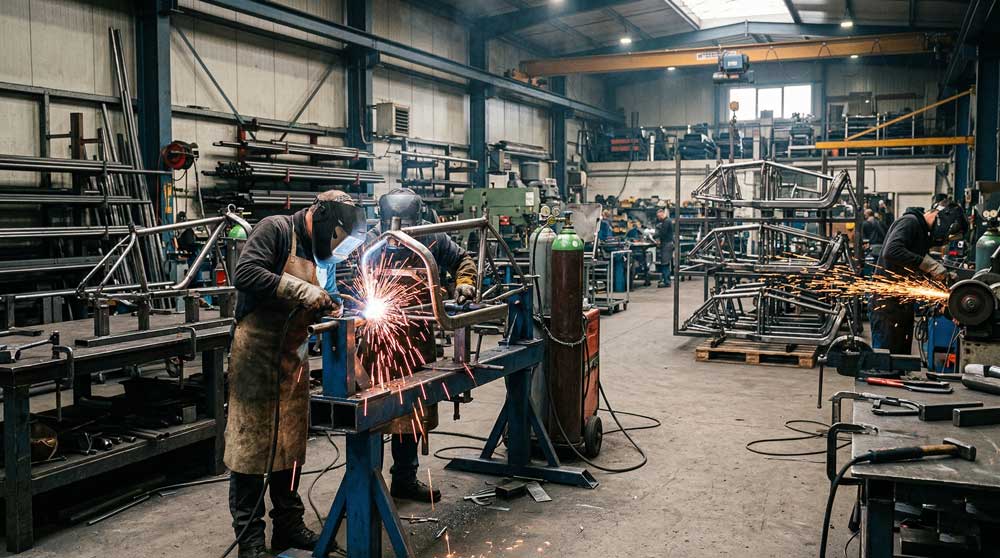
In cargo bike manufacturing, the most critical process is frame production. It defines structural integrity, alignment, and ultimately the reliability of the entire vehicle. This is why a serious audit always goes beyond the assembly line and into the welding and fabrication area.
You are not just looking for equipment, but for consistency. Welding quality should be uniform, fixtures should be used to ensure repeatability, and workflows should be organized rather than improvised. These details indicate whether the factory can produce at scale without introducing variability.
This is also where understanding basic product structure becomes important. If you are not already familiar with how cargo bikes are built, reviewing resources like Cargo Bike Anatomy: A Complete Guide to Parts and Types or A Practical Guide on How to Read Cargo Bike Specification Sheet will significantly improve your ability to interpret what you see during an audit.
5. Supply Chain Control Is the Hidden Risk Layer
Even if a factory performs well internally, its reliability depends on external partners. Motors, batteries, braking systems, and even frames may come from specialized suppliers. If these upstream partners are unstable, your delivery timeline becomes unpredictable.
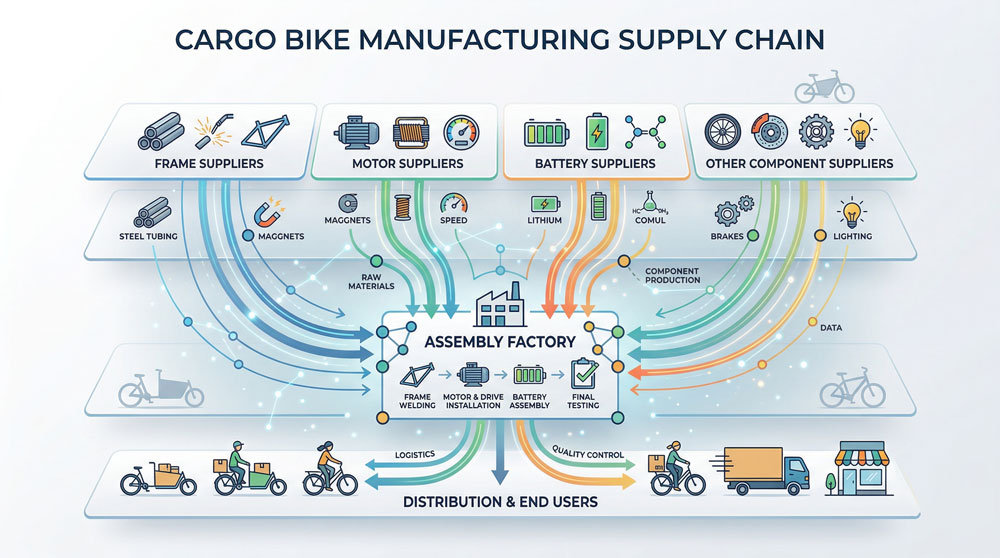
A proper audit includes evaluating how the factory manages these dependencies. Supplier evaluation records, subcontractor control procedures, and purchasing documentation provide insight into whether the factory actively manages its supply chain or simply reacts to it . The difference becomes visible when delays occur.
Buyers who ignore this layer often misjudge risk. They assume that a strong factory guarantees strong delivery, when in reality the weakest supplier in the chain can determine the outcome.
6. Compliance: The Area Most Buyers Underestimate
For buyers operating in different countries, compliance is no longer optional. Beyond product certifications, factory conditions themselves are increasingly under scrutiny.
A more rigorous audit should include basic checks on:
- fire safety systems (clear exits, extinguishers, evacuation plans)
- employee working conditions (reasonable hours, no forced labor)
- legal employment practices (contracts, attendance records)
Documents such as employee rosters, training records, and attendance logs provide indirect evidence of workforce management . While these may seem unrelated to product quality, they are closely linked to operational stability. Factories with poor labor practices often experience high turnover, which directly affects production consistency.
In many cases, these risks do not appear during standard audits but emerge later as delivery issues or quality fluctuations.
7. The Human Factor: How Problems Are Handled
Machines and documents provide structure, but people determine outcomes. During an audit, pay attention to how factory representatives respond to detailed questions. Clear, consistent answers usually indicate familiarity with internal processes, while vague responses often suggest gaps in coordination.
In Chinese manufacturing environments, issues are sometimes managed internally before being communicated externally. This means that delays or problems may not be reported immediately. Understanding this behavior allows you to interpret communication patterns more accurately after the audit.
This is also where your earlier negotiation strategy connects directly. A supplier that feels accountable to you — not just contractually, but relationally — is more likely to escalate issues early rather than hide them.
8. Product Compliance & Market Certification: What Determines Whether You Can Actually Sell
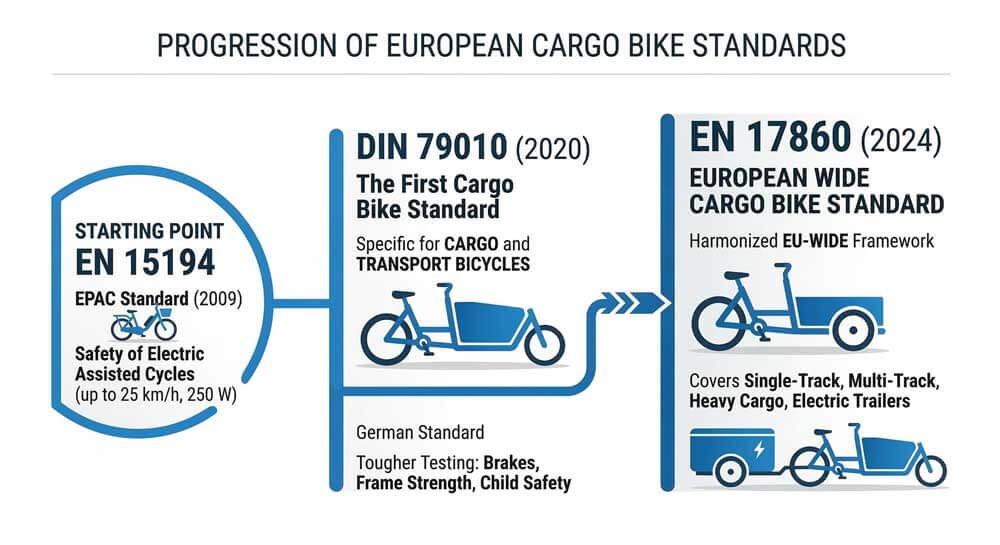
Factory compliance tells you whether a supplier operates responsibly.
Product compliance determines whether you can legally sell what they produce.
These are often confused, but they solve completely different problems.
A factory may pass internal audits, maintain acceptable working conditions, and operate with proper documentation. None of that guarantees that the cargo bikes they produce meet the regulatory requirements of your target market. For buyers in Europe, North America, or Australia, this distinction becomes critical the moment products enter customs or are placed into operation.
For the European market, CE marking is not just a label — it represents conformity with multiple directives, including machinery safety, electromagnetic compatibility, and battery regulations. Serious suppliers should be able to provide complete documentation packages, often supported by third-party testing bodies such as TÜV Rheinland or similar accredited institutions. These reports should not be generic; they must correspond to the exact product configuration you are sourcing.
In the United States, the regulatory landscape is more fragmented but equally strict. Depending on the product category, compliance may involve UL certification for electrical systems, CPSC requirements for bicycle safety, and additional state-level regulations. A supplier that cannot clearly explain how their product aligns with these frameworks is not ready for export at scale.
The distinction between OEM and ODM projects becomes particularly important here. For mature, standardized models, certifications should already exist and be verifiable. For ODM projects, the supplier should demonstrate not only awareness of certification requirements but also the capability to support testing, documentation, and potential design adjustments required to pass compliance.
A useful way to evaluate this is to look beyond the certificate itself. Ask how the testing was conducted, which components were included in the tested configuration, and whether any changes have been made since. Certification is not static. Even small modifications in battery, motor, or frame structure can invalidate previous reports.
Ultimately, product compliance is not just a regulatory requirement. It is a proxy for how well a supplier understands international markets. A factory that treats certification as a checkbox is very different from one that integrates it into product development.
The Real Goal: Understanding Risk, Not Eliminating It
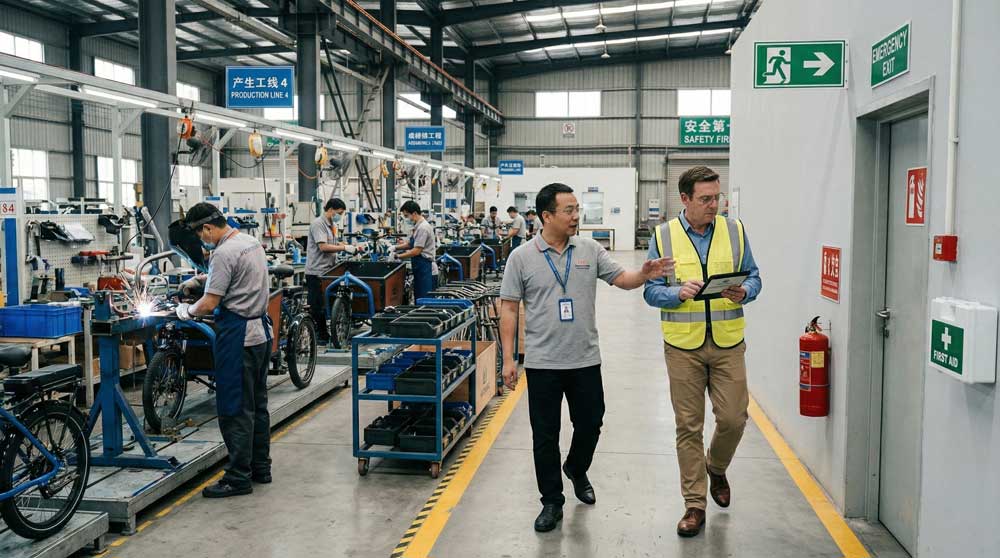
A common mistake is expecting a perfect factory. In practice, no supplier operates without flaws. The objective of an audit is not to eliminate risk, but to understand where it exists and whether it can be managed.
A factory with transparent processes and clear documentation is often more reliable than one that appears flawless but lacks depth. What matters is not the absence of problems, but the ability to detect and resolve them consistently.
This perspective also changes how you compare suppliers. Instead of looking for the best factory, you are identifying the one that aligns with your project’s priorities and risk tolerance.
Free Download: Cargo Bike Factory Audit Sheet (Excel/Editable)
Final Insight
A cargo bike factory audit is not a checklist exercise.
It is a way to understand how a supplier behaves under pressure — when timelines slip, components are delayed, or quality issues appear.
Because those situations are not exceptions.
They are part of the process.
Want more operator-level cargo bike intelligence? Follow CargoBikeHub — we cover sourcing, fleet ops, and market shifts for people who work in the industry, not just write about it.
Table of Contents
- A Factory Audit Is Not a Visit — It Is a System Check
- 1. The First Step: Verify Identity Before Capability
- 2. Documentation Is Not Formality — It Reveals How the Factory Thinks
- 3. Production Capability Is About Flow, Not Output
- 4. The Frame Workshop Is Where You See the Truth
- 5. Supply Chain Control Is the Hidden Risk Layer
- 6. Compliance: The Area Most Buyers Underestimate
- 7. The Human Factor: How Problems Are Handled
- 8. Product Compliance & Market Certification: What Determines Whether You Can Actually Sell
- The Real Goal: Understanding Risk, Not Eliminating It
- Final Insight


