

Urban logistics teams are asking a very practical question today:
Should we deploy a three wheel cargo bike fleet or move directly to four-wheel cargo bikes (cargo quadricycles)?
This is not a theoretical debate anymore. Cities are tightening access rules, operators are building micro-hubs, and last-mile fleets need vehicles that balance payload, maneuverability, infrastructure access, and total cost of ownership (TCO).
Large logistics companies are already scaling cargo bike delivery networks. For example, Amazon announced in 2026 that it has completed more than 100 million deliveries in Europe using small electric vehicles including cargo bikes, supported by micromobility hubs across more than 50 cities. (data from Amazon news)
That shift is forcing fleet managers and mobility planners to rethink which cargo bike architecture actually works best in dense cities.
This article focuses on three wheel cargo bike vs four wheel cargo bike, and also explains why two-wheel cargo bikes are usually excluded from heavy urban logistics fleets.
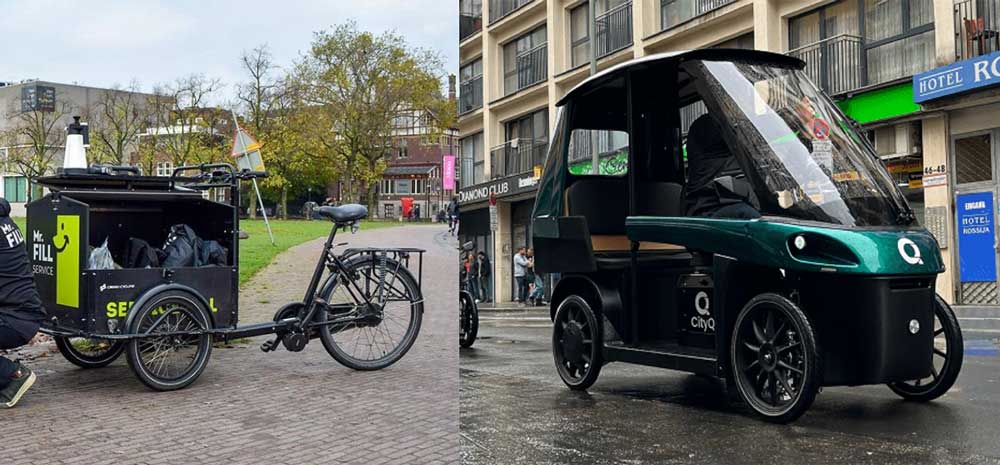
Three Wheel Cargo Bike: The Core Platform of Urban Cargo Fleets
The three wheel cargo bike has become the most widely adopted platform for urban logistics because it balances capacity, regulation compatibility, and maneuverability.
Typical load ranges for cargo trikes are around 100–300 kg, depending on configuration and protection level.
But the real story is in the architecture differences which directly affect handling, loading efficiency, and safety. (To know more about cargo bike classification and knowledge, read Cargo Bike Anatomy: A Complete Guide to Parts and Types, Cargo Bike Types: How the Industry Actually Classifies Them)
Two Main Structural Designs
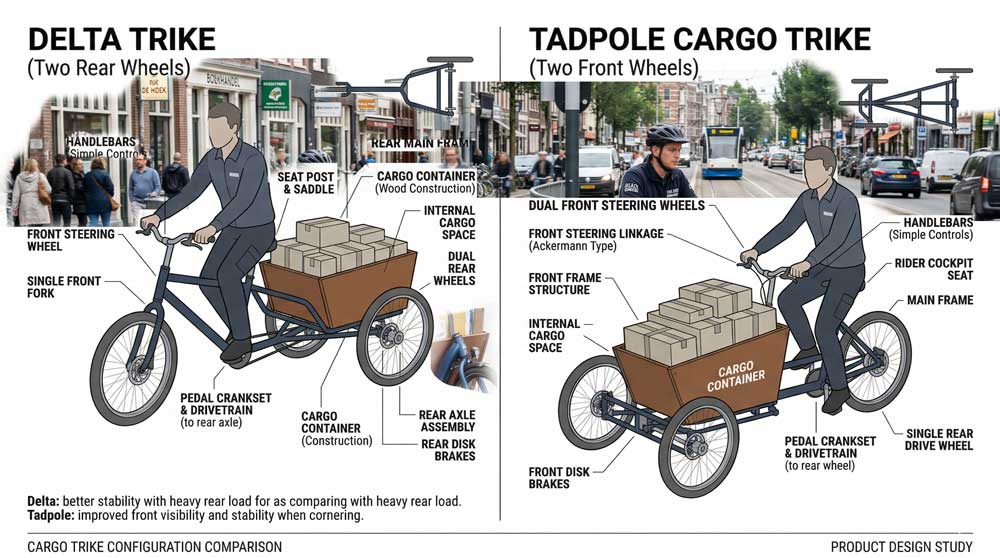
Delta Configuration (One Front Wheel, Two Rear Wheels)
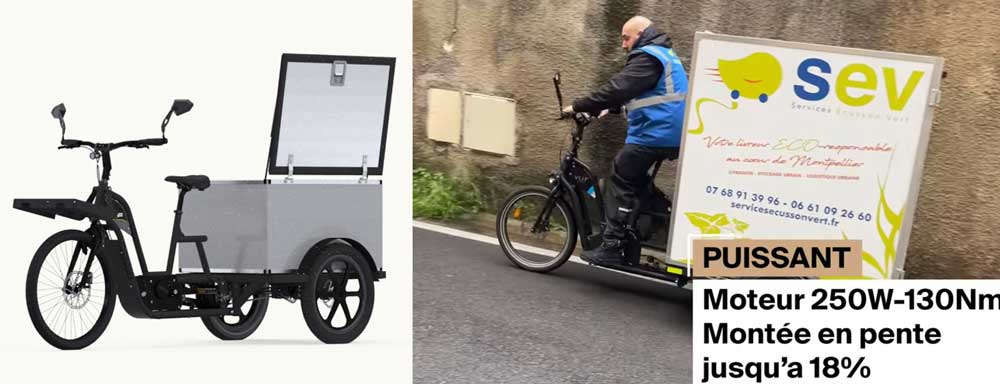
This design places the cargo area either:
- between the rear wheels, or
- on a rear platform
Key characteristics:
- simpler drivetrain integration (rear axle driven)
- higher load tolerance on the rear frame
- commonly used in postal and industrial delivery
However:
- steering is less stable under high speed or sharp turns
- front wheel carries less load, affecting braking dynamics
In practice, delta designs are often used in heavier-duty but lower-speed logistics scenarios.
Example manufacturer:
Tadpole Configuration (Two Front Wheels, One Rear Wheel)
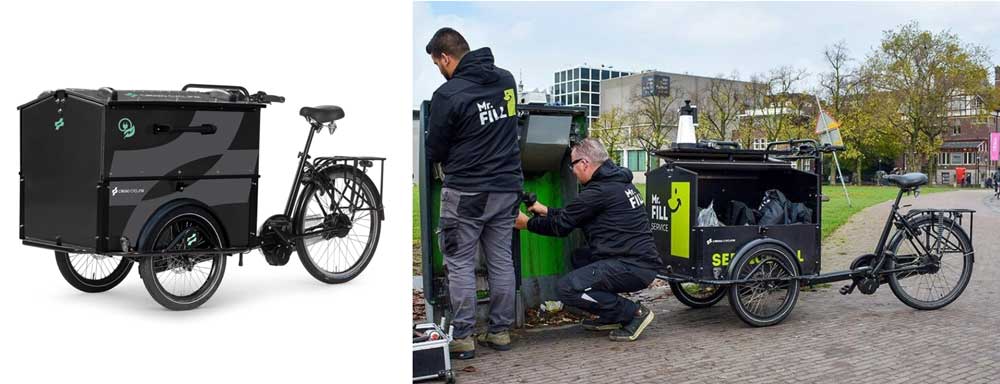
This layout positions the cargo box at the front, between two wheels.
Key characteristics:
- superior braking stability (two front wheels handle most braking force)
- better load distribution for front cargo boxes
- improved safety perception in traffic
Trade-offs include:
- more complex steering system
- higher manufacturing cost
Many modern urban delivery trikes now include:
- Tilting mechanisms(Butchers & Bicycles)
- Modular cargo boxes(Read What is Modular Cargo Bike?)
- Weather-protected compartments
This is the dominant configuration in modern urban parcel delivery fleets.
Example brands:
Power System and Drivetrain
Three-wheel cargo bikes usually rely on:
- Mid-drive motors (Bosch, Shimano, or custom fleet systems)
- 500–1000 Wh battery setups (sometimes dual battery)
- Chain or belt drive transmissions
Energy consumption benchmarks from European cycle logistics data show around 1.0–2.5 kWh per 100 km depending on configuration and weight.
This makes them extremely efficient for dense city delivery.
Why Operators Like Three Wheel Cargo Bikes
From an operations perspective:
- They can usually remain legally classified as bicycles.
- They are allowed on many bike lanes in Europe (depending on width).
- They work well with micro-hub logistics models.
- Drivers require less training compared with quadricycles.
However, there are trade-offs.
Trikes can become unstable if poorly loaded or cornered aggressively, although modern suspension and tilting systems are improving this.
Four Wheel Cargo Bikes (Quadricycles): The Emerging Logistics Vehicle
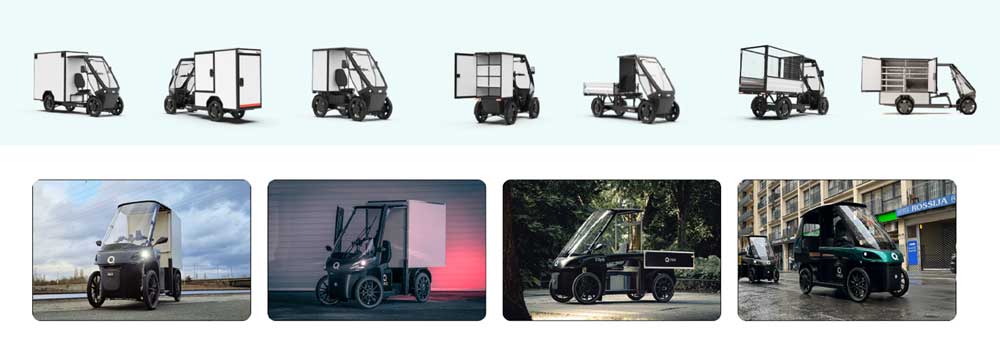
Cargo quadricycles are becoming more visible in European and North American logistics networks.
Examples include:
- Vok Bikes
- CityQ (Deployed by DHL)
- Electric Assisted Vehicles(EAV)
These vehicles are effectively micro-electric delivery vehicles with pedals, designed to operate between bicycles and small vans.
Typical payload can reach up to about 500 kg depending on design, which is significantly higher than most trikes.
Some operators are even exploring large-scale deployments. For instance, Amazon is working with Rivian-related technology partners to deploy pedal-assist four-wheel cargo vehicles in cities across the US and Europe.(source from Theverge news)
Structural Advantages of Quadricycles
Four-wheel cargo bikes provide:
- Much better lateral stability
- Larger cargo modules
- Better weather protection
- Automotive-style braking and suspension
- Enclosed cabin + High stability
This makes them suitable for:
- Grocery delivery
- Heavy parcel routes
- Suburban logistics
- High-volume B2B supply runs
But there are constraints.
Infrastructure and Regulation Limits
This is where many operators hesitate.
Compared with a three wheel cargo bike, quadricycles:
- Are wider
- Have a larger turning radius
- Sometimes cannot access narrow bike lanes
- May require different classification depending on local law
In dense historic European city centers, that can be a decisive factor.
Some cities allow them on bike infrastructure; others treat them closer to light electric vehicles.
Power System Differences: Pedal-Assist vs Vehicle-Type Drive
One of the most overlooked differences between a three wheel cargo bike and a four wheel cargo bike is not the motor itself, but how the power system is designed and regulated.
Three Wheel Cargo Bike: Pedal-Assist Dominant
Most three wheel cargo bikes used in urban logistics operate under pedelec systems, meaning:
- the motor only provides assistance when the rider is pedaling
- power output is typically limited (e.g. 250W in EU regulations)
- top assisted speed is usually capped at 25 km/h
This design allows them to:
- remain legally classified as bicycles
- access bike lanes and low-emission zones
- avoid licensing and insurance requirements in many markets
This is why nearly all large-scale cargo bike fleets rely on pedal-assist systems.
Four Wheel Cargo Bike: Hybrid or Throttle-Based Systems
Four wheel cargo bikes (quadricycles) often move closer to vehicle-type power systems, which may include:
- throttle control (no pedaling required)
- higher power output
- larger battery systems
However, this comes with trade-offs:
- may fall outside standard bicycle regulations
- restricted access to bike infrastructure in some cities
- potential need for registration or licensing
In practice, many quadricycles are designed to operate in a regulatory grey zone between bicycles and light electric vehicles.Range, Speed and Real-World Efficiency
Speed is often misunderstood in cargo logistics.
Most cargo bikes — including trikes and quads — are limited to 25 km/h electric assist in many regions to remain classified as bicycles.
But operational efficiency depends on:
- Parking availability
- Traffic congestion
- Delivery density
- Route design
Cargo bikes can outperform vans in city centers because they avoid congestion and parking constraints.
Where quads sometimes win is route consolidation:
one vehicle can carry more goods per trip.
Where trikes win is urban accessibility.
Maintenance and TCO Reality
Fleet operators increasingly evaluate cargo bikes like commercial vehicles.
Typical differences:
Three Wheel Cargo Bike
Lower upfront cost
Simpler maintenance
More suppliers available
Faster fleet scaling
Four Wheel Cargo Bike
Higher initial investment
More complex mechanical systems
Higher battery capacity
But potentially fewer trips required
In cycle logistics studies, energy use for quads is typically 2.0–3.5 kWh/100 km, slightly higher than trikes but still far lower than electric vans.
This is why many operators run mixed fleets.
Why Two-Wheel Cargo Bikes Are Usually Not in This Comparison
Two-wheel cargo bikes — mainly longtail and long-john/front-loader designs — are extremely useful, but they serve a different role.
They are:
- More compact
- Easier to ride like a normal bicycle
- Better for short-range delivery or narrow streets
- Faster to deploy for small parcel density routes
However, their limitations become obvious in commercial logistics:
- Lower payload compared with trikes and quads
- Smaller cargo volume
- Stability issues with heavy loads
- Limited battery capacity due to frame constraints
Modern cargo bikes used commercially typically carry 40–250 kg depending on design, but heavier logistics use cases increasingly require more capacity and structural stability.
In other words:
Two-wheel cargo bikes are great courier tools. Three-wheel and four-wheel platforms are logistics vehicles.
Quick Decision Guide for Operators
| Operational Scenario | Recommended Vehicle |
|---|---|
| Dense historic city center | Three wheel cargo bike |
| Narrow bike lane infrastructure | Three wheel cargo bike |
| High parcel density | Either (route dependent) |
| Grocery or bulky deliveries | Four wheel cargo bike |
| Suburban mixed traffic routes | Four wheel cargo bike |
| Early-stage cargo bike fleet | Three wheel cargo bike |
| Large logistics scaling | Mixed fleet strategy |
The Direction the Industry Is Moving
The next phase of cargo logistics is already visible.
Three trends are emerging:
1. Hybrid fleets
Operators deploy trikes for dense delivery zones and quads for consolidation routes.
2. Modular cargo systems
Standardized boxes and swappable cargo units are becoming more important than the vehicle itself.
3. Regulation shaping vehicle design
Future cargo bikes will likely be designed specifically to comply with:
- Bike lane width standards
- micro-hub logistics models
- urban emission zones
The three wheel cargo bike will likely remain the backbone of urban cargo fleets, while quadricycles gradually expand into heavier urban logistics roles.
Final Insight: The Real Question Operators Should Ask
The real decision is not
three vs four wheels.
It is:
What type of urban network are you building?
If your operation depends on:
- micro-hubs
- dense drop-off zones
- short delivery cycles
a three wheel cargo bike fleet scales faster.
If your network aims to replace vans across wider urban areas, quadricycles may become unavoidable.
Most successful operators are already planning for both.
Haven’t found the right manufacturer for your cargo bike brand? Explore our cargo bike manufacturers list and supply chain information. More cargo bike industry trends, please keep following CargoBikeHub!
Table of Contents
- Three Wheel Cargo Bike: The Core Platform of Urban Cargo Fleets
- Four Wheel Cargo Bikes (Quadricycles): The Emerging Logistics Vehicle
- Power System Differences: Pedal-Assist vs Vehicle-Type Drive
- Maintenance and TCO Reality
- Why Two-Wheel Cargo Bikes Are Usually Not in This Comparison
- Quick Decision Guide for Operators
- The Direction the Industry Is Moving
- Final Insight: The Real Question Operators Should Ask


