

If you have been reading about Eurobike 2026 anywhere in the last few months, there is a good chance you have been reading a story that no longer exists. Most published guides still describe a show where cargo bikes are being moved out to a new sister event called Mobifuture, leaving the main hall to road, gravel and MTB. That plan is dead. Quietly, and with surprisingly little fanfare in English-language coverage, cargo bikes have won the argument over what Eurobike is supposed to be.
For anyone sourcing, specifying, distributing or building cargo bikes for the European market, the version of Eurobike that opens in Frankfurt on June 24 is not just a smaller show. It is a different show, with a different centre of gravity and a different commercial logic. Here is what actually matters — and how to make the most of it.
What Actually Changed: A Six-Month Industry Earthquake
Eurobike 2026 was originally pitched as the first “back to the roots” edition: sport, performance, lifestyle, with everything urban, electric and commercial spun off into a co-located Mobifuture show in Hall 6. That blueprint went public in July 2025.
By the end of October, two of Germany’s most influential industry bodies, ZIV (Die Fahrradindustrie) and Zukunft Fahrrad, had withdrawn from the show after negotiations on a joint 10-point reform plan collapsed. Within days, Bosch eBike Systems confirmed it would not exhibit in 2026. Shimano followed in January 2026 with a full withdrawal, before partially reversing course to attend only with an outdoor demo area. Specialized, SRAM and Scott had already been absent for years.
In mid-November 2025, Eurobike’s organiser Fairnamic dropped the Mobifuture spin-off entirely. Cargo bikes, e-cargo platforms, light commercial vehicles and urban mobility products are now back under the main Eurobike umbrella in 2026. ZIV has since confirmed it is developing its own international cycling trade fair, targeted for autumn 2027, alongside a planned merger with Zukunft Fahrrad.
So Eurobike 2026 is a four-day show (down from five), in fewer halls, with fewer global motor and groupset giants — but with cargo bikes squarely at the centre.

Cargo Bikes Were the Crux of the Whole Fight
A detail that has been buried in most coverage is worth highlighting: the 10-point plan published by ZIV and Zukunft Fahrrad explicitly demanded that EPAC25 (electrically assisted bikes, including e-cargo) be treated as core to Eurobike, not relocated to Mobifuture as a secondary category.
In other words, the industry pushback that reshaped the show was, in large part, a fight to keep cargo and urban e-bikes in the main hall. That is not a small symbolic detail. It tells you where European trade bodies see the growth — and where serious commercial visitors will spend their time in Frankfurt this June.
If your cargo bike strategy assumed you were being moved to a niche side event, the assumption is wrong. You are in the main room now, by industry consensus.
The New Cargo Bike Map: Hall 8 and Hall 12

The compacted 2026 layout actually makes life simpler for cargo-focused visitors. Three halls are active:
- Hall 11 — sport and performance: road, gravel, MTB, premium components.
- Hall 12 — leisure and ecomobility: this is where finished consumer cargo bikes, urban e-bikes, trikes and family models concentrate, alongside commercial last-mile platforms.
- Hall 8 — global sourcing: OEMs, ODMs, component suppliers, frame builders and contract manufacturers.
For a buyer or fleet operator, the practical implication is that two halls cover almost everything cargo-relevant. Component decisions for cargo platforms — drive units, gearboxes, brakes, batteries — sit primarily in Halls 8 and 11. Finished consumer and commercial cargo bikes sit in Hall 12. There is no need to walk between six halls as in past editions.
Outdoor demo zones, including the test track and the Saturday Festival Day programme, are where most cargo e-bike test rides happen. Slots are typically tight; book directly with exhibitors before arrival rather than relying on the general signup.
The Drive System Question No One Wants to Ask
With Bosch eBike Systems sitting out, every cargo bike specification conversation in Frankfurt this year has a quietly different shape. Bosch has been the default mid-drive for premium European cargo platforms for years. Their absence does not affect supply chains, but it removes the social proof of a flagship booth and reorders who gets seen first.
What is left in the show is interesting in its own right:
- Mahle is positioning lightweight drive systems relevant to longtail and urban cargo configurations, where overall weight is a retail differentiator.
- Pinion is showcasing its integrated motor-gearbox unit — a sealed, low-maintenance drivetrain with a strong case for service-bike and shared-mobility applications, where derailleur replacement cycles dominate total cost of ownership.
- Tektro Europa and FSA cover braking and groupset specifications, both increasingly relevant to designs written against EN 17860 cargo structural requirements.
- Several Chinese mid-drive and hub-motor specialists are using the Bosch-shaped gap to push harder on visibility, with new high-torque cargo-specific units on the floor.
If you spec cargo bikes, this is the year to seriously stress-test alternatives rather than defaulting to the incumbent.
A Window for OEM and ODM Sourcing
The other quiet story of Eurobike 2026 is that the reduced presence of major Western brands has opened unusual floor-space and media oxygen for Asian cargo bike manufacturers. The Hall 8 global sourcing roster is the densest it has been in years, with established names like United Mobility, Luxmea, Regen and TARRAN sitting alongside newer entrants pitching modular family cargo platforms, heavy-duty trikes for logistics, and white-label longtails.
For European brand owners, this is a working buyer’s market. MOQs are softer than 2023–2024, EU-warehoused inventory is more common, and several manufacturers will now quote DDP terms rather than insisting on FOB. For fleet procurement teams, it is also the first Eurobike where a full technical file — CE, EN 17860 test reports, EN 15194 drive certification, EN 50604-1 battery documentation — can realistically be reviewed at the booth instead of being promised by email afterwards.
The practical advice: arrive with a written spec sheet, a target landed cost, and a sample-evaluation timeline. Factories that cannot meet those conversations on day one will reveal themselves quickly.

Compliance Just Became the Centre of the Conversation
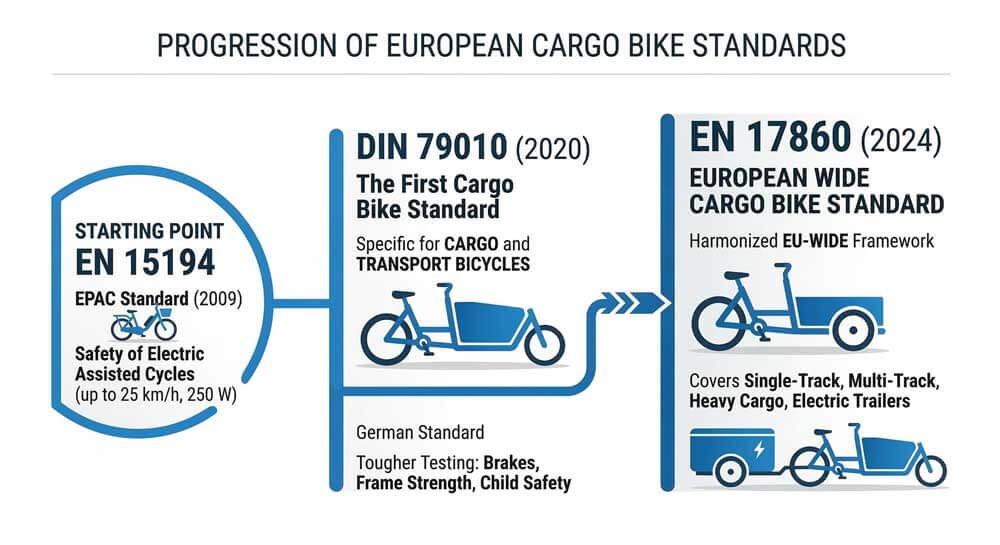
Eurobike 2026 is the first major European cargo bike show staged under the full EN 17860 series, the new harmonised standard for carrier cycles. Two details matter for commercial buyers in particular.
First, EN 17860 differentiates between private and commercial use, with commercial e-cargo bikes required to withstand roughly twice the dynamic pedalling load cycles of private-use bikes. Any importer planning fleet sales should be asking factories for test reports against the commercial profile, not the private one. A factory quoting only EN 15194 for a loaded cargo platform is not, in 2026, taking compliance seriously.
Second, anyone shipping cargo bikes or batteries into the United States now sits inside a separate regulatory window. California’s SB-1271 has required certified e-bike batteries (UL 2271) and systems (UL 2849) statewide since January 1, 2026, layered on top of New York City’s existing mandates. Combined with EN 50604-1 tightening in Europe, the compliance technical file is no longer an afterthought — it is a procurement gate.
Expect serious buyers in Halls 8 and 12 to ask for documentation in the first conversation, not the third. Brands that can hand over a technical file at the booth will close opportunities faster than those who promise to “send it through”.
Looking Past June: The 2027 Question
The story does not end on June 27. ZIV has confirmed plans for its own international cycling trade fair, targeted for autumn 2027, and is merging with Zukunft Fahrrad to consolidate industry representation. Eurobike, for its part, has acknowledged that 2026 is a transitional edition and that a redefined format is expected from 2027 onwards.
For cargo bike brands and OEM partners, this creates a real 2027 budgeting question. There will likely be two competing major European platforms next year, both claiming to represent the industry. Decisions about exhibition spend, sample shipping and product launch timing made in summer 2026 will shape visibility well into 2028.
The pragmatic read: treat Eurobike 2026 as both a working show and a reconnaissance trip. The exhibitors you meet, the test rides you take, and the conversations you have about 2027 plans will matter as much as the brochures you collect.

Frequently Asked Questions
When and where is Eurobike 2026?
June 24–27, 2026, at Messe Frankfurt. The show is four days long, one day shorter than previous editions.
Is Mobifuture still happening in 2026?
No. The standalone Mobifuture format was cancelled in November 2025. Cargo bikes and urban e-mobility products are back under the main Eurobike umbrella.
Which halls house cargo bikes at Eurobike 2026?
Hall 12 for finished consumer and commercial cargo bikes, urban e-bikes and trikes. Hall 8 for OEM, ODM and global sourcing partners. Hall 11 is sport and performance.
Are Bosch and Shimano exhibiting at Eurobike 2026?
Bosch eBike Systems is not exhibiting. Shimano is running an outdoor demo area only, without a traditional booth.
Which standards should a cargo bike meet for the EU in 2026?
EN 17860 for mechanical and structural performance (with commercial-use bikes tested to a higher cycle count), EN 15194 for the electric drive system, and EN 50604-1 for battery compliance. For US-bound shipments, plan for UL 2271 and UL 2849.
Will there be a competing European cycling trade fair?
ZIV has announced plans for a new international cycling trade fair targeted for autumn 2027, in addition to Eurobike 2027.
More info about cargo bike global exhibitions, please check Events&Expos Page.
Want more operator-level cargo bike intelligence? Follow CargoBikeHub — we cover sourcing, fleet ops, and market shifts for people who work in the industry, not just write about it.
Table of Contents
- What Actually Changed: A Six-Month Industry Earthquake
- Cargo Bikes Were the Crux of the Whole Fight
- The New Cargo Bike Map: Hall 8 and Hall 12
- The Drive System Question No One Wants to Ask
- A Window for OEM and ODM Sourcing
- Compliance Just Became the Centre of the Conversation
- Looking Past June: The 2027 Question
- Frequently Asked Questions


