
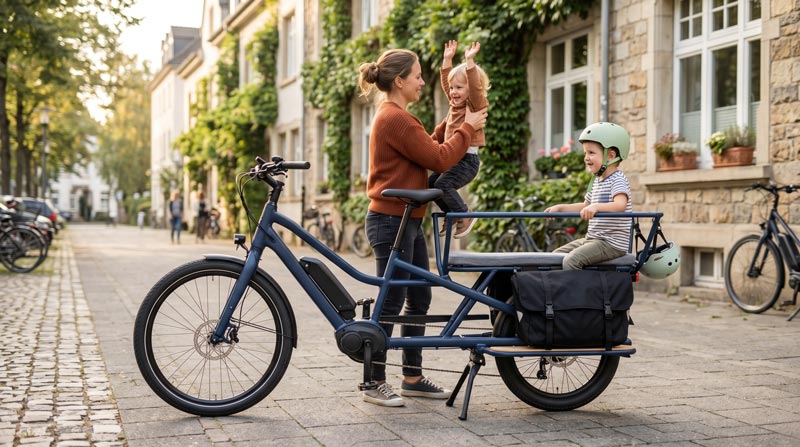
Family cargo bikes replace a second car, not a bicycle — and in 2026 they are the largest private driver of cargo bike sales in Europe.
Standard bike share replaces a short trip; delivery fleets grab the headlines. But the quiet engine of the whole category is the family cargo bike — the bike a parent buys to do the school run, the shop and the nursery drop-off without a car. For retailers, private-label brands and distributors, that reframing is the whole game: the buyer is comparing the bike to a second car, not to another bicycle, and decides on storage, stability and trust long before motor specs.
This is the operator's map of that opportunity — the types, the demand, the new safety bar, what sells and how to source it — drawn from the six deep-dives in our family cargo bike cluster and grounded in primary data throughout.
The three types — and who each one fits
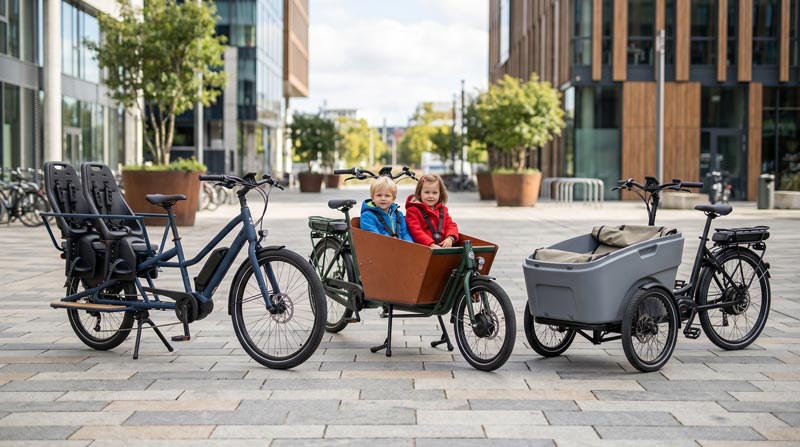
Almost every family cargo bike is one of three layouts, and the cleanest way to tell them apart is to count the wheels and find the load. Match the type to the household and the sale closes; mismatch it and you book a return — the category's single most common cause of dissatisfaction.
Longtail 1–2 kids
Two wheels, load at the rear. Rides closest to a normal bike, fits a hallway, gentlest learning curve. The urban default — and the format winning the most volume.
Box bike / bakfiets 2–3 kids
Two wheels, load at the front in a low box. Kids ride in view; swallows bulky cargo. Needs storage and a weather cover, and leans like a bike — so it must be balanced when you stop.
Trike 4+ kids / accessibility
Three wheels, self-standing. Won't tip when you load a child and feels rock-solid at walking pace, but it's wider and doesn't lean. For big families, daycares and riders worried about balance.
The point most first-time buyers miss: a two-wheel box bike and a three-wheel trike can carry the same front box but behave nothing alike. The full breakdown — with 18 best-selling models and how format preferences differ by country shows which to stock for which market.
Where the demand is — and what it's worth
Germany sold a quarter of a million private cargo bikes in a single year; the rest of Europe sits well behind, and North America is earlier still. The gaps track subsidy design, secure storage and protected infrastructure — not awareness. The household maths is what drives the switch.
- 235,250 private cargo bikes sold in Germany in 2024 (up from ~60,000 in 2018) — almost all electric, almost all family. Source: ZIV
- ~50% of electric cargo bike journeys replace a car trip; in one UK trial, 20% of households bought their own within a year. Source: UKRI / Geoforum
- £4,000 a year a UK family saves by swapping a second-hand second car for an e-cargo bike plus public transport. Source: Clean Cities
- 320+ low-emission zones now operate across Europe, pushing urban families off four wheels and lifting e-cargo adoption. Source: Mordor Intelligence
- Europe — premium and defended. Front box + mid-drive + full safety/accessory suite, sold through dealers. The moat is compliance and the accessory ecosystem: EN 17860, subsidy eligibility, a deep parts catalogue a price-led rival can't copy quickly.
- North America — scale and contested. Longtail + hub motor + one all-in price, sold largely direct. The battlefield is the price band — Aventon lands a Tern-style longtail at roughly half the price, accessories bundled in.
Subsidy reality has shifted toward business buyers: France's national bonus ended in February 2025 (support is now regional), Germany has no national private grant but BAFA reimburses businesses 25% up to €3,500, and the EU's Social Climate Fund opens new purchase support from 2026. The full country-by-country market, subsidies and the US picture sets out where to point inventory.
What's new in 2026: the bar moved from bike rack to car seat
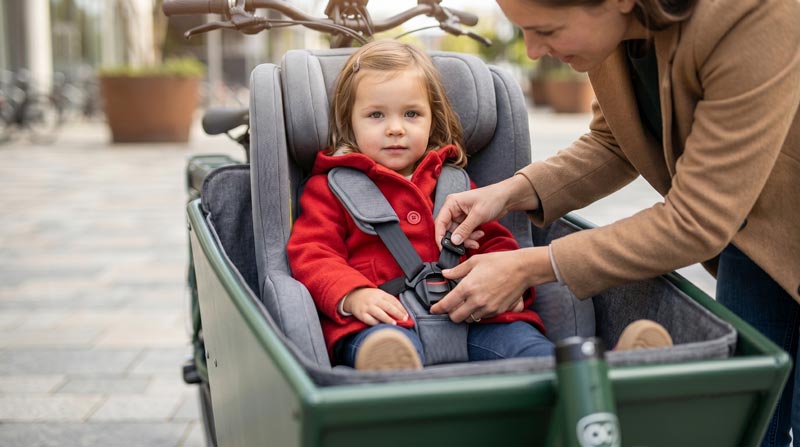
The most important shift in the category is a change in what "safe" means. Premium parents no longer measure child carrying against a bicycle rack — they measure it against a car seat, and the products winning design juries reflect it. Germany's Ca Go won Red Dot 2025 for a crash-tested "safety cell": a five-point harness anchored into the frame, ISOFIX-compatible child seats, an F1-style roll collar, and a floor battery well that drops the centre of gravity. At the value end, TENWAYS' Longtail Duo took the iF Design Award 2026 on pure user experience — low step-through, contactless unlock, tool-free shared fit, built-in tracking.
Most longtail rear seats and trike boxes still sit at "add a guardrail." That gap between expectation and median product is the opportunity. The lesson for B2B: UX and child-safety engineering are now spec lines, not finishing touches — covered in what makes a family cargo bike sell.
Are cargo bikes safe for kids?
Yes — a cargo bike built to today's standards and handled correctly is a safe way to carry children, and for short urban trips it often replaces a higher-risk car journey. The risks are specific and knowable: frame integrity (the lesson of the Babboe recall), battery fire (solved by certification), and the standstill tip when loading a child. The standards that now define safe are EN 17860:2024 for the bike and UL 2849/2271 for the battery — the latter increasingly mandatory in markets such as New York and California. For sellers, safety is also the cheapest moat: factory-made safety documentation, openly named certifications and honest pros-and-cons selling earn the word-of-mouth price never buys. The standards, the risks and the seller's trust playbook goes deeper.
The school run: the sharpest wedge into the category
The trip that drives the purchase is the school run. In London, school drop-off accounts for over a quarter of morning peak car traffic, and for the 1–2 mile journey — too far to walk with kids, trivial for an e-bike — roughly 65% of families currently drive. That is the e-cargo bike's home turf, and the demand has a calendar: it peaks at back-to-school, so the seller who lands stock and finance offers before September captures the decision. Why the drop-off sells family cargo bikes sets out the spec and the seasonality.
Build or resell? Sourcing a family cargo bike line
One legal fact reframes the whole sourcing decision: under EU rules, putting your logo on a cargo bike makes you its legal manufacturer, with all the liability that carries. A generic white-label frame therefore hands you a manufacturer's risk with none of the differentiation. Defensibility lives elsewhere — in cargo-specific certification, a working service-and-spares operation, an accessory ecosystem, and visible trust. Decide what will be defensible first; choose build-versus-resell second; spec the frame last. Private label, ODM and the white-label trap walks through the sourcing gates, and the cargo bike manufacturers directory is where to start comparing factories.
The family cargo bike cluster: six B2B deep-dives
Read in this order — from what the products are, to where the demand sits, to how to win and source it.
Bottom line
The family cargo bike is not one product — it is three types, two business models, and one rising safety bar. The brands that win in 2026 won't have the highest payload number; they'll match format, price model and certification to where demand actually lives, solve the physical objections of storage and stability, and meet the new car-seat-grade expectation. Demand is the easy part; getting the type, the trust and the supply chain right is the work.
Frequently asked questions
What is a family cargo bike?
A family cargo bike is a bicycle — usually electric — purpose-built to carry children and everyday loads over short urban distances. It is bought to replace a second car rather than another bike, with longtail, box-bike (bakfiets) and trike the three main types.
Which type is best — longtail, box bike or trike?
There is no universal best; there is the right type for a household. Longtails suit 1–2 kids and storage-tight homes; box bikes suit 2–3 kids and bulky cargo; trikes suit 4+ kids, accessibility needs and riders worried about balancing at a standstill.
Are cargo bikes safe for children?
Yes, when built to EN 17860 and UL 2849, fitted with a stable stand or three wheels, and handled with basic knowledge — and they often replace a higher-risk car trip. Premium models now use car-seat-grade restraints and independent crash testing.
Can a family cargo bike really replace a car?
For many urban families, yes. Around half of electric cargo bike journeys replace a car trip, and a UK family saves roughly £4,000 a year by swapping a second car for an e-cargo bike plus public transport.
Where is the family cargo bike market growing fastest?
Germany leads Europe by a wide margin (235,250 private units in 2024), with France, the Netherlands and Belgium behind and the UK accelerating off a low base. North America is earlier-stage and longtail-led.
Should a retailer build a private-label cargo bike or resell an existing brand?
Decide what will be defensible first. Under EU law, branding a bike makes you its legal manufacturer, so a generic white-label frame carries full liability with no differentiation. Own certification, service, accessories and trust, then choose.